If you’re actively looking to buy an automatic bottle filler machine in 2026, you’re probably not just browsing—you’re trying to solve a real production problem: speed, consistency, labour, hygiene, or scaling into retail and distribution.
The issue is that “automatic” can mean very different things depending on the machine design, your product type, and your output goals. Two machines can look similar online, but one will run smoothly for years and the other will cause constant stoppages, spills, and expensive downtime.
This buyer-focused guide explains what to check before buying an automatic bottle filler machine in South Africa—so you choose a machine that fits your product, your bottles, and your growth plan.
Watch the machine in action below:
Before you compare prices, get clear on what you’re filling. The best automatic bottle filler machine depends heavily on viscosity, foaming, and cleaning requirements.
Ask yourself:
Is it thin (water, thin drinks) or thick (sauce, syrup, honey)?
Does it foam (juice, detergents, some cleaners)?
Does it contain pulp or particles?
Does it need food-grade hygiene and fast cleaning between batches?
A machine that works perfectly for water can struggle with thicker liquids, foamy products, or anything with pulp.
Many buyers say “I need an automatic bottle filler machine,” but the real question is how much you need to produce per hour.
Think in these terms:
What do you need to produce per day?
How many hours will you actually run production?
What output do you need to grow over the next 12–24 months?
If you buy a machine that only meets today’s demand, it becomes a bottleneck fast. A better approach is choosing an automatic bottle filler machine that matches current needs and allows growth without replacing the whole unit.
Bottle compatibility causes the most headaches in real operations.
Before purchasing an automatic bottle filler machine, confirm:
bottle height range
bottle diameter range
neck finish / mouth size
whether you’ll run multiple bottle sizes
realistic changeover time between sizes
If you plan to run 500ml and 2L bottles, for example, you want a machine designed for quick, stable adjustments—not something that needs constant fiddling and downtime.
A lot of machines can fill bottles. Fewer can fill them cleanly, consistently, and with minimal spillage.
For buyers, two checks matter a lot:
Uneven fills look bad on shelves and cause complaints. Ask:
how the machine controls dosing
whether it maintains consistency over long runs
whether it can handle different fill volumes reliably
Wet bottles are a nightmare for labelling and packaging. A good automatic bottle filler machine should reduce drips and keep bottles clean around the neck.
This is one of the biggest “quality signals” in retail.
If you’re bottling anything edible (water, juice, oil, sauces) cleaning and hygiene aren’t optional.
Before buying, check:
contact parts material (food-grade where required)
how easy it is to access and clean components
how long a normal clean-down takes
whether the design has dead zones that trap residue
whether the machine supports frequent changeovers
A machine that’s “fast” but takes forever to clean will slow your operation down more than you expect.
Many buyers start with filling and later add capping and labelling. That’s fine—if the machine is chosen with expansion in mind.
If your end goal is a full line, confirm whether your automatic bottle filler machine is compatible with:
automatic capping
labelling machines
conveyors and accumulation tables
date coding
shrink wrapping or carton packing
A machine that integrates cleanly will save you major headaches later.
In South Africa, after-sales support is a big deal. Buyers often focus on the purchase price but underestimate what downtime costs when something small fails and parts aren’t available.
Before you buy an automatic bottle filler machine, ask:
Are spares readily available?
What’s the lead time on consumables and wear parts?
Do you offer installation and training?
What support is available if the line stops?
Reliability plus support is often what makes the difference between a smooth operation and a constant headache.
If you’re looking to buy an automatic bottle filler machine in South Africa in 2026, SA Packaging Machinery can recommend the right setup based on your product, bottle type, and output goals—so you avoid common buyer mistakes and choose a machine that scales with you.
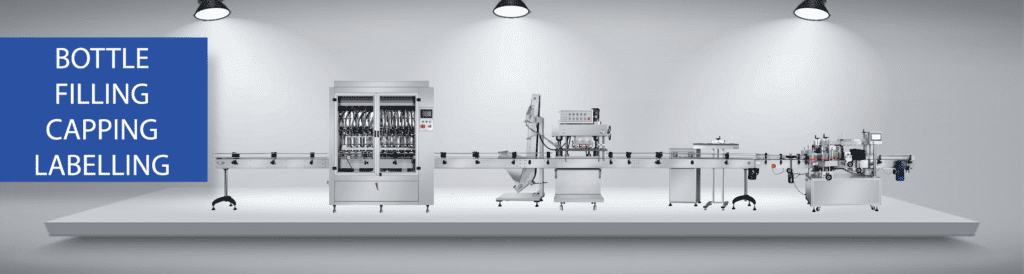
Integrates filling, screw capping, and labelling of various products.
An automatic bottle filler machine fills bottles using an automated system that controls dosing, timing, and bottle handling to deliver consistent fill levels with less manual labour. Many systems can also be integrated with capping, labelling, and conveyors for a complete line.
It depends on the filling method and configuration, but common products include water, juice, soft drinks, oils, sauces, syrups, detergents, sanitizers, and cosmetics. Always confirm viscosity, foaming, and whether the product contains pulp or particles.
Output varies by machine type, bottle size, and product characteristics (foam/thickness). The best way to estimate is to share your bottle size + target fill volume + product type and request a realistic bottles-per-hour figure.
Yes, most can—within a defined range. Ask about:
bottle height/diameter limits
changeover time
whether additional parts or tooling are needed
Not always. Some setups are filling-only, while others can be integrated into a full line. If you plan to scale, it’s smart to choose an automatic bottle filler machine that can integrate with capping, labelling, date coding, and conveyors later.
A simple rule:
Thin liquids (water): flow/gravity style options often work well
Foamy liquids (some juices/detergents): controlled fill speed and anti-drip helps
Thick liquids (sauces/syrups): piston/pump-type solutions are usually better
Your supplier should recommend the correct method based on your product.
Buying purely on price without checking:
product compatibility
cleaning time and hygiene design
spillage/drip control
spare parts availability and support
It depends on design and product type. Ask the supplier for:
typical cleaning time between batches
access points for cleaning
whether the machine is designed for frequent changeovers
Often yes—especially if you’re losing time to manual bottling, wasting product through spills/overfills, or trying to scale into repeat orders. The ROI usually comes from labour savings, higher throughput, and reduced waste.
Send:
product type (and whether it’s foamy/thick/pulpy)
bottle sizes and material (PET/glass)
cap type
target output (bottles per hour/day)
whether you want integration with capping/labelling now or later