
Most articles about a bottle filling machine tell you what machines are. That’s not what buyers struggle with.
In 2026, the real pain is buying a machine that looks perfect on a brochure… and then discovering it doesn’t hit your weight accuracy, can’t handle your bottle range, takes forever to clean, or becomes unusable because spares/support are slow.
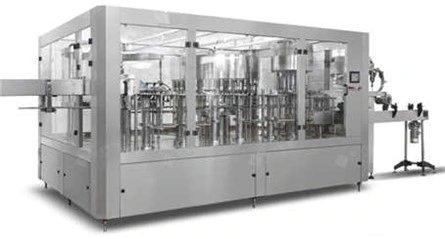
See the machine in action below:
Before you ask anyone for a price, lock these in:
Product: what you’re filling (thin / foamy / viscous / particulate)
Fill volume range: e.g., 250ml–2L (or whatever you run)
Bottle range: height + diameter + neck finish, and how many bottle formats you’ll run
Output target: bottles/hour (your real minimum acceptable)
Changeover & cleaning target: max minutes you can tolerate between SKUs / bottle sizes
These five make suppliers stop guessing and start engineering.
Send this to any supplier:
Subject: Quote Request – Bottle Filling Machine (South Africa, 2026)
1) Product details
Liquid type:
Foamy? (Y/N):
Viscosity (thin/medium/thick):
Particulates/pulp? (Y/N):
Temperature at fill:
2) Bottle details
Bottle material (PET/HDPE/Glass):
Sizes (ml):
Bottle height range:
Bottle diameter range:
Neck finish / cap type:
3) Performance requirements
Target output (bottles/hour):
Accuracy requirement (± ml or %):
Acceptable spillage/drip level: “Clean bottles suitable for immediate labelling” (Y/N)
4) Operations
SKUs per day/week:
Cleaning frequency:
Max cleaning time allowed:
Max changeover time allowed (bottle size):
5) Integration (now or later)
Capping required now?
Labelling required now?
Conveyors/accumulation tables required?
Date coding required?
6) Support
Installation included?
Training included?
Spare parts lead time (in SA):
Warranty terms:
Then end with:
Please quote: machine price, recommended configuration, estimated throughput for our product, utilities required, and delivery/installation timeline.
This alone makes your bottle filling machine quotes 10x more usable.
When quotes come back, score each supplier on these 8 items (1–5):
Throughput with your product (not max speed)
Accuracy guarantee (in writing)
Bottle range compatibility (proof, not “should work”)
Clean fill result (drip control / splash control)
Cleaning time & access (tool-less? easy strip-down?)
Changeover time (bottle size + fill volume)
Spare parts availability in South Africa
Installation + training + support response
The highest score is usually the safest bottle filling machine purchase—not the cheapest quote.
Serious buyers request a Factory Acceptance Test (FAT) using their bottles/product (or a close match).
Your FAT should prove:
output can be sustained for a continuous run (not 5 minutes)
fill accuracy stays consistent across the run
bottles come out clean enough to label (no mess around neck/body)
reject/stop logic behaves safely if bottles misfeed
changeover steps are demonstrated (not explained)
If a supplier won’t do a FAT, that’s a risk flag for a bottle filling machine purchase.
Two machines can have the same “price” but totally different 2-year cost.
Ask each supplier for:
recommended wear parts list + annual replacement estimate
maintenance schedule
typical consumables (seals, nozzles, etc.)
expected downtime points and how they’re resolved
service call availability (SA-based or remote only)
A “cheap” bottle filling machine gets expensive fast if it stops often or parts take weeks.
“Max speed” quoted with no mention of your product/bottle
No written accuracy range
Vague answers about cleaning/changeovers
No clarity on spares stock or lead times
No installation/training plan
Refusal to run a FAT or demonstrate your bottle range
These are the classic reasons buyers regret a bottle filling machine purchase.
If you want help speccing and selecting the right bottle filling machine for your product and bottle range, SA Packaging Machinery can guide you through the RFQ process and recommend a configuration that matches your output goals.
Contact SA Packaging Machinery today for a quote
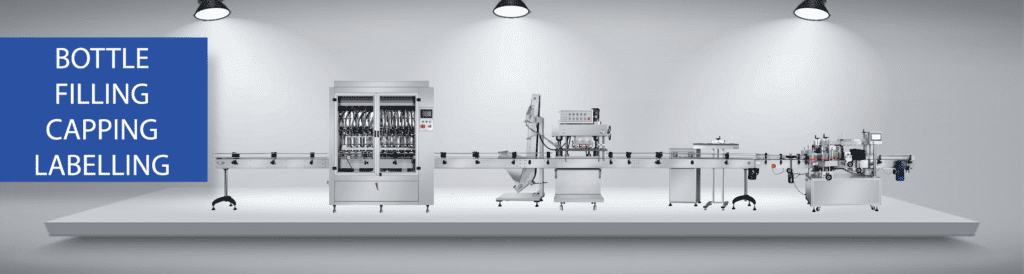
Integrates filling, screw capping, and labelling of various products.
To get a usable quote, send your product type (thin/foamy/thick/with particles), fill volume range, bottle sizes/material/neck finish, your target bottles per hour, and your cleaning/changeover needs. The more specific you are, the less “generic” the quote will be.
Because real speed depends on your product behaviour, bottle stability, fill volume, and whether the machine must control foam, drips, or accuracy. Always ask for realistic throughput with your product, not maximum theoretical speed.
Compare using the same criteria: throughput (with your product), accuracy (in writing), bottle range compatibility, clean-fill performance, cleaning/changeover time, spare parts availability, and support/training. Don’t compare only on price.
A FAT is a test run before final payment where the supplier demonstrates the machine meets your requirements (output, accuracy, clean fill, bottle handling). Yes—serious buyers request a FAT to reduce risk.
Often yes, within a defined range. Confirm the bottle height/diameter range, what change parts are needed (if any), and the expected changeover time between sizes.
Accuracy depends on the filling method and product. Buyers should specify their acceptable tolerance (e.g., ±ml or ±%) and ask the supplier to confirm it in writing and ideally demonstrate it during a test run.
The main causes are drips, splashing, and unstable bottle positioning during filling. Ask about anti-drip control, nozzle shut-off, and how the machine keeps bottles clean enough for immediate labelling.
Very important. Downtime is expensive. Ask what spares are kept locally, typical lead times, whether installation/training is included, and how support works when the line stops.
That can work if your bottle filling machine is selected with integration in mind. Confirm compatibility with cappers, labellers, conveyors, coding, and the space/layout required for a future line.
Buying on price without confirming product compatibility, real throughput, cleaning/changeover time, and local support. The cheapest quote can become the most expensive machine once downtime and rework start.