If you’re searching for a bottling machine in 2026, you’re not really buying “a machine.” You’re buying a production line outcome:
bottles come out clean
fills are consistent
caps don’t leak in transport
labels go on straight
your team can run it daily without chaos
Most buyers make a mistake right here: they compare bottling machines like a single product, when the real success comes from how the line is designed around your workflow.
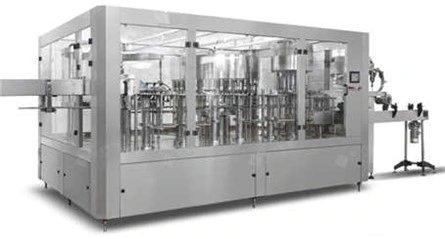
See the machine in action below:
A supplier can show you speed, stainless steel, and automation buzzwords. But the questions buyers should care about are:
Will it run my bottle type without tipping or jamming?
Will it keep bottles clean enough to label immediately?
Will it keep caps consistent so I don’t get leaks and returns?
Can we clean it fast between SKUs?
Can we add equipment later without ripping the line apart?
A bottling machine that can’t deliver those results is just an expensive bottleneck.
Most bottling operations fall into one of these three line types:
lower output, fewer operators
ideal for startups or small batch production
usually filling + capping first, labels later
consistent throughput
reduced manual handling
designed for repeat orders and reliability
clean presentation is non-negotiable
tight fill consistency, reliable cap application
often includes coding + inspection as standard
When you ask for a quote, you should tell suppliers which line type you’re building—because the “right” bottling machine is different for each.
A bottling machine is usually one module inside a line. In 2026, buyers typically build around these modules:
Bottle infeed (table, unscrambler, staging)
Rinsing / sanitising (optional, common for food/water)
Filling (the core bottling machine function)
Capping
Labelling
Coding (batch/date)
Packing (shrink wrap, cartons, case packing)
Buyer tip: you don’t need all seven on day one, but you should buy in a way that doesn’t block you from adding the next module later.
Light PET bottles, tall bottles, or odd shapes can wobble or tip. That triggers:
misfills
jams
spills
downtime every hour
A good bottling machine proposal should explain how bottles are stabilised during fill and transfer—not just “it can run PET.”
If bottles come out wet around the neck or body, you’ll fight:
label lift/wrinkling
dirty-looking bottles
rework and wiping
Ask suppliers to describe how they reduce drips and splashing.
A bottling machine line that fills perfectly but caps inconsistently will destroy trust in distribution. Confirm:
cap type compatibility
consistent torque/application method
how misapplied caps are handled
If you run flavours, scents, or different SKUs, cleaning can become your biggest time sink. Ask:
cleaning steps
typical clean-down time
tool-less access or parts removal requirements
A credible quote will provide:
expected bottles/hour using your bottle size and product behaviour
assumptions (foam/thickness, fill volume, cap type)
If the quote only shows maximum theoretical speed, it’s not a production-ready recommendation.
Even if you start with filling + capping only, your line should allow:
conveyor integration
label and coding additions
inspection and packing upgrades
A bottling machine that can’t integrate smoothly usually costs more later.
Buyers should treat this as part of the purchase, not an afterthought:
spares availability and lead times
installation and training
support response when the line stops
When you message suppliers, include this paragraph to get better quotes:
“We are looking for a bottling machine setup for [product type]. We run bottles sized [X–Y ml], bottle material [PET/glass], cap type [type], and need [target bottles/hour]. We need clean bottles suitable for labelling and want a setup that allows future labelling/coding integration. Please recommend the best configuration and provide realistic throughput for our product.”
This forces suppliers to respond with an engineered recommendation, not a generic sales list.
A strong supplier will include:
a proposed line layout (even a simple diagram)
realistic output assumptions
changeover and cleaning expectations
recommended add-ons if you’re scaling (conveyors, accumulation, coding)
clear support plan and spares availability
If you get those, you’re dealing with someone who understands production—not just selling equipment.
If you’re ready to buy a bottling machine in South Africa in 2026, SA Packaging Machinery can help you design the right line setup based on your product, bottle type, output goals, and expansion plan—backed by 3 decades of experience supplying packaging and bottling solutions. Contact SA packaging machinery today
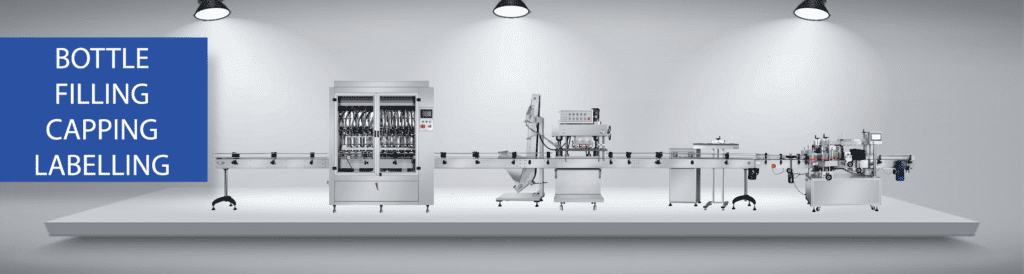
Integrates filling, screw capping, and labelling of various products.
A bottling machine usually refers to the core filling (and sometimes capping) equipment. A complete bottling line includes multiple stages like infeed, rinsing, filling, capping, labelling, coding, and packing. Many businesses start with a bottling machine and expand into a full line as they scale.
Start with four things: your product, your bottle sizes/material, your cap type, and your target bottles per hour. A supplier should recommend a configuration based on those inputs—not just offer a generic “standard machine.”
Often yes, within a defined range. You should confirm the machine’s supported bottle height and diameter range, whether change parts are required, and how long a realistic changeover takes between sizes.
The most common causes are drips, splashing, and unstable bottle positioning during filling. If bottles come out wet, labels can wrinkle or lift later. Ask suppliers how their bottling machine controls drips and keeps bottles clean enough for immediate labelling
Work backwards from demand: how many bottles you must produce per day/week and how many hours you’ll run production. Then add a buffer for growth. Always request realistic output with your product and bottle, not “maximum speed.”
That’s common. If you plan to expand, choose a bottling machine that can integrate with cappers, labellers, conveyors, coding, and packing equipment later—so you don’t have to replace the core unit.
Very important—especially if you run multiple SKUs (different flavours/scents/products). Cleaning time directly affects daily output and labour costs. Ask for typical clean-down time and what parts need to be removed or accessed.
Common mistakes include buying on price alone, ignoring bottle compatibility, not planning for cleaning/changeovers, believing “max speed” claims, and not confirming local spares/support.
It depends on the product and your hygiene requirements. Many food/water lines include rinsing or sanitising as part of the process, while some products may not require it. A supplier should advise based on your application.
Send:
product type (thin/foamy/thick/with particles)
bottle sizes and material (PET/glass)
cap type
target bottles per hour/day
whether you need labelling/coding now or later
This helps suppliers recommend the right bottling machine configuration and avoid vague quotes.