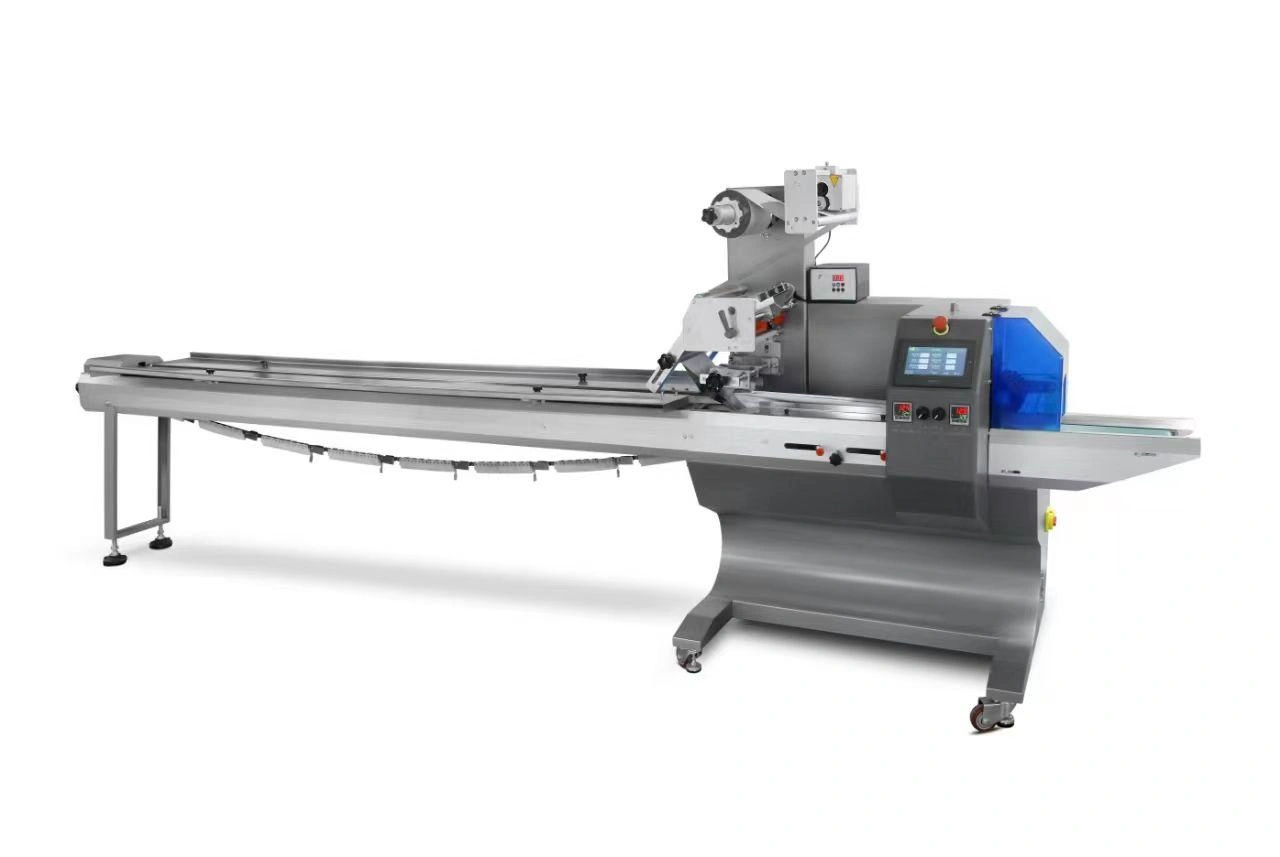
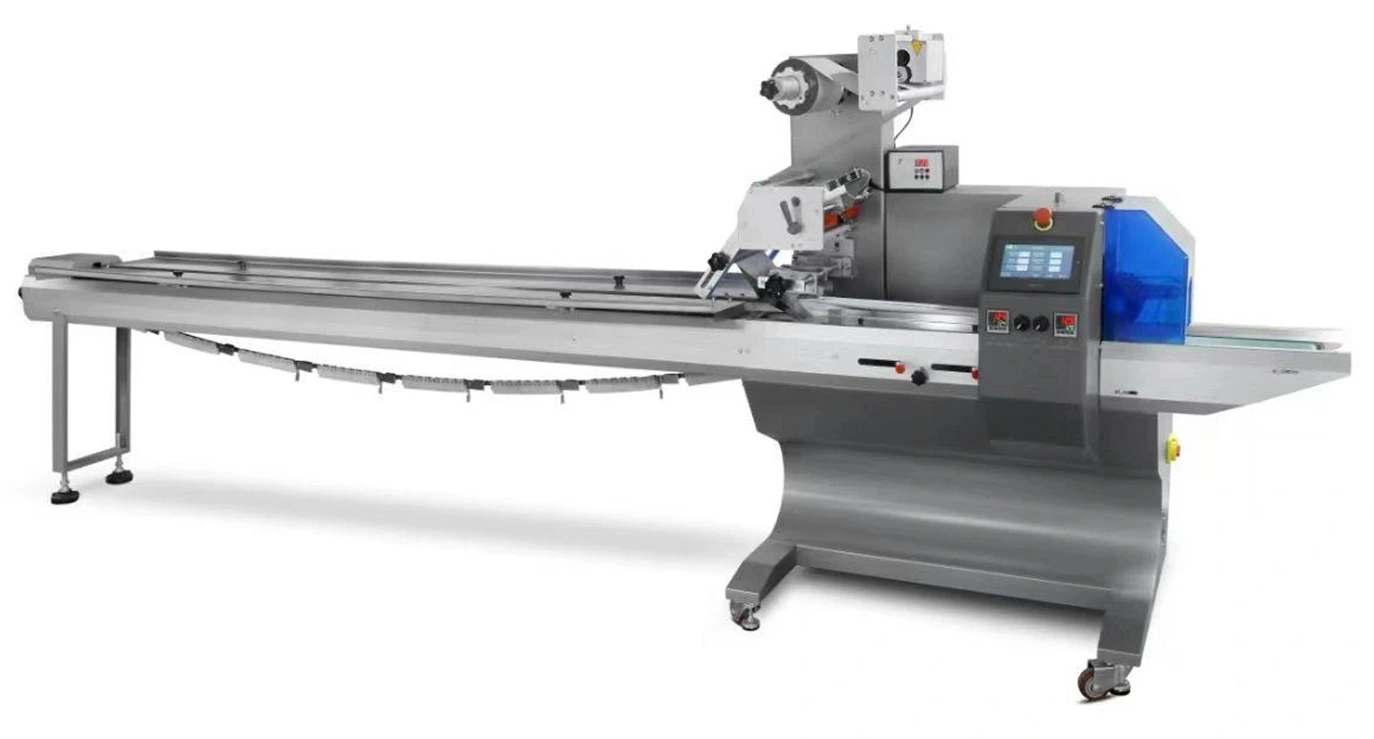
Machine Overview
| Machine type | Horizontal flow wrap (pillow pack) |
| Products | Solid single items, trays, punnets and multipacks |
| Output | 40–230 packs/min depending on model and product |
| Configurations | Top-roll chain pusher or bottom-roll belt conveyor; single or double cutters |
| Pack format | Pillow pack with fin seal and end seals |
| Film | BOPP, PE, PET and laminates on rollstock |
| Controls | Touchscreen PLC, servo drives, colour-mark film tracking |
| Options | Gas flushing, date coder, tray or punnet infeed, line integration |
Configurations
A flow wrap machine is specified by how the film is fed and how the pack is cut. The film feed decides how the product is supported through the wrapper; the cutter decides the pack length range and the speed ceiling. The four options below combine into the machine that suits your product.

01
The standard flow wrapper. Film feeds from above and the product is pushed along a lugged infeed chain into the wrapping tube, then sealed underneath and cut. Fastest and simplest configuration for solid, uniform products.
Best for
•Biscuits, chocolate bars, sponge cakes
•Soap bars and boxed goods
•Any solid product that slides easily on the infeed
Benefits
Highest speeds
Simplest changeover
Lowest cost configuration
02
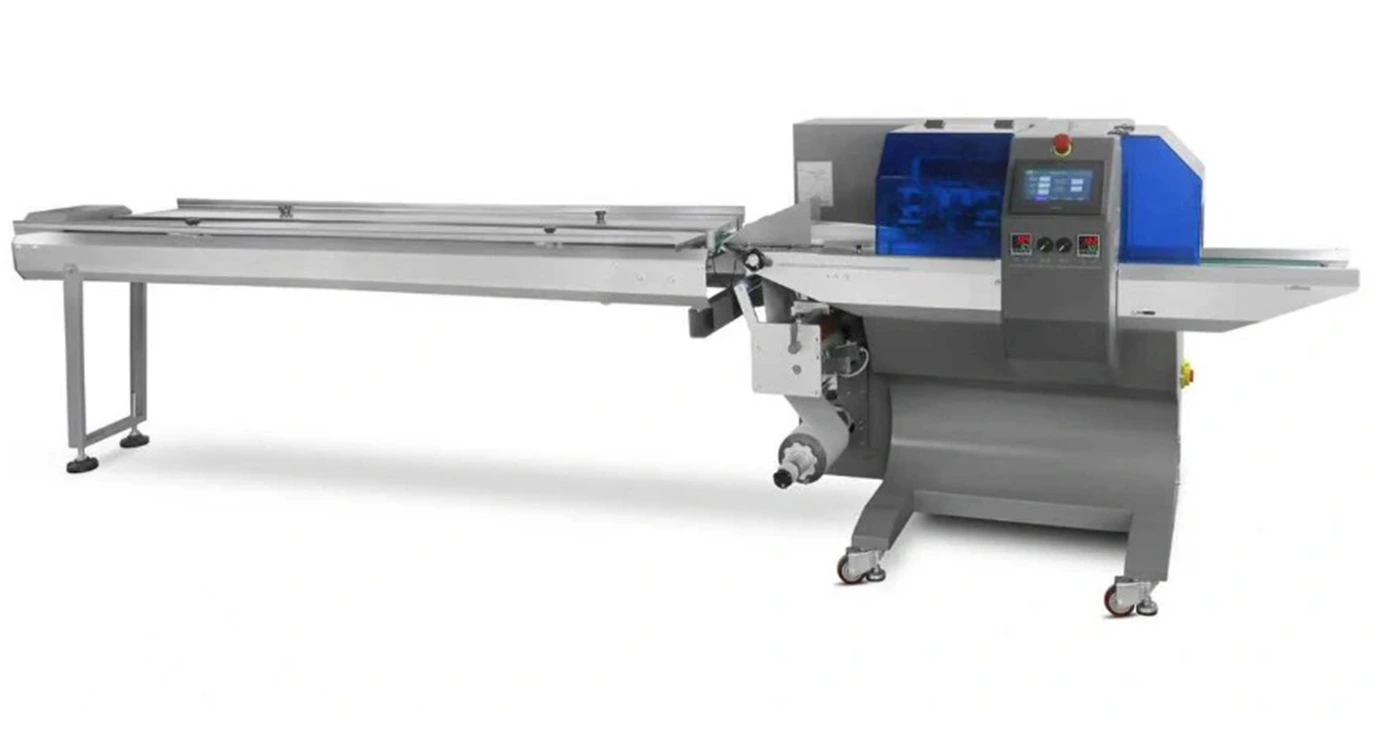
Film feeds from below and the product rides on the film itself along a belt conveyor, so it is supported rather than pushed. Used where the product is fragile, sticky, heavy or made up of loose pieces.
Best for
•Greeting cards, loose hardware, tortillas
•Soft or delicate produce
•Sticky or multi-component products
Benefits
Product carried on film, not pushed
Handles fragile and sticky items
Very long pack lengths (up to 2 m)

03
One end-seal and cut per rotation of the cutting head. The standard cutter, and the one to choose when pack length varies or products are long.
Best for
•Baguettes, large trays, multipacks
•Product lengths that change between runs
Benefits
Widest pack-length range
Lower wear per cycle
Flexible across products

04
Two end-seals and cuts per rotation, doubling output on short packs. Fitted for high-speed lines running small, consistent products.
Best for
•Hard sweets, biscuits, mints
•Small items at industrial speeds
Benefits
Up to 230 packs/min
Shorter minimum pack length
Industrial-level throughput
Models
Three frame sizes cover products from a single mint to a 270 mm wide tray. Each is built in top-roll or bottom-roll form, with low or high cutters to suit product height, and can be specified with servo drives, gas flushing and coding.
The compact model for small and medium products: film width 80–340 mm, bag width 30–160 mm, product height to 40 mm (low cutters) or 60 mm (high cutters).
40–230 packs/min
Top-roll or bottom-roll
Single or double cutters
220 V, 2.4–2.6 kW

The mid-range workhorse: film width up to 440 mm, bag width 80–200 mm, product height to 80 mm or 100 mm. The model in most of our case studies.
40–100 packs/min (top-roll)
Bottom-roll to 2 m pack length
3-servo option
220 V, 2.8 kW

The wide-web model for trays, multipacks and large bakery items: film width to 590 mm, bag width 100–270 mm, product height to 100 mm (customisable to 120 mm).
20–80 packs/min
Top-roll or bottom-roll
Customisable product height
220 V, 3.2 kW

Three-servo drives for print registration and quick recipe changeover, stainless steel food and pharma builds, tray and punnet infeeds, automatic feeders and integration with cartoning or shrink lines.
Servo film, infeed and cutter drives
Automatic product feeding
Gas flushing and coding
Full line integration
Applications

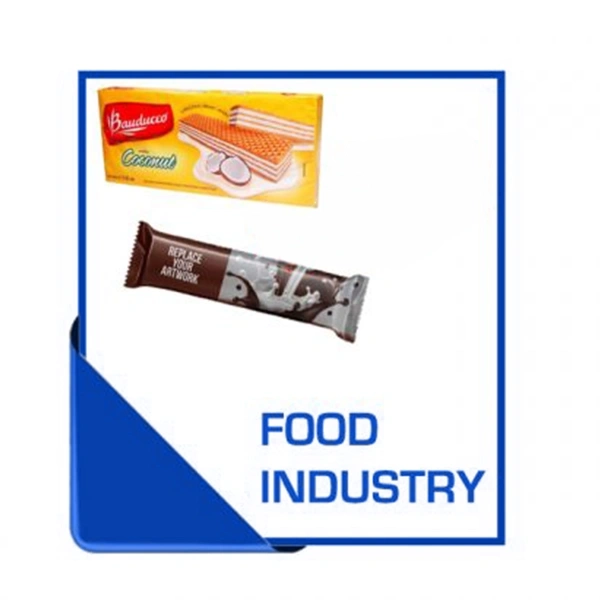
Food and bakery. Flow wrapping is the standard pack for solid food that needs a sealed, hygienic, shelf-ready wrap:
Biscuits, bread, buns and pastries
Chocolate bars and confectionery
Fresh produce and trays
Frozen foods and ready-meal components
Snack, protein and granola bars

Personal care and hygiene. Non-food products that are wrapped for protection, tamper evidence and presentation:
Soap bars
Wet wipes
Cosmetic kits
Hygiene products
Napkins and cutlery sets
Medical, hardware and industrial. Items that must arrive clean, counted and sealed:
Syringes, test kits and disposables
Surgical instruments
Over-the-counter healthcare products
Small parts, fasteners and spares
Stationery and retail goods
The guides below cover the applications we are asked about most; each explains the film, infeed and cutter configuration that suits the product.
Bakery and snacks: bakery products · buns · croissants · pastries · biscuits · crackers and breadsticks · energy and granola bars · chips · nuts
Confectionery and produce: confectionery · chocolate · snack bars · fresh produce
Non-food: soap bars · napkins · cutlery sets · medical products · non-food products · retail display packs
Background: flow wrap film types · SAP-250 vs SAP-350 vs SAP-450 specifications
Specifications
Flow wrap machines are specified by film width, bag length and width, product height, speed and power. The table gives the working ranges for each model in top-roll and bottom-roll form; low and high cutters set the maximum product height on the SAP-350, and the 80 and 100 variants do the same on the SAP-450 and SAP-600.
Film width. Size the film to the product before choosing the model: film width = (product width + product height) × 2 + 40 mm. The 40 mm allowance covers the fin seal and sealing margins. Apply it to the largest product you intend to run so the film stays within the model’s range.
Every model can be built top-roll (chain pusher infeed) or bottom-roll (belt conveyor infeed), with single or double cutters, and in stainless steel for food and pharmaceutical production. CE certificates are available on request.
Output falls as pack length rises: the packs-per-minute figures below apply to short products; long products on bottom-roll machines are rated in metres of film per minute instead.
| Model | Film width | Bag length | Bag width | Max product height | Speed | Power |
|---|---|---|---|---|---|---|
| SAP-350 Top (low / high cutters) | 80–340 mm | 65–280 mm (double) / 120–330 mm (single) | 30–160 mm | 40 mm / 60 mm | 40–230 packs/min | 220 V, 2.4 kW |
| SAP-350 Bottom (low / high cutters) | 120–340 mm | 65–2000 mm | 50–160 mm | 40 mm / 60 mm | 10–25 m/min | 220 V, 2.6 kW |
| SAP-450 Top (80 / 100) | 180–440 mm | 150–450 mm | 80–200 mm | 80 mm / 100 mm | 40–100 packs/min | 220 V, 2.8 kW |
| SAP-450 Bottom (80 / 100) | 160–440 mm | 150–2000 mm | 80–200 mm | 80 mm / 100 mm (to 120 mm) | 10–20 m/min | 220 V, 2.8 kW |
| SAP-600 Top (80 / 100) | 240–580 mm | 150–450 mm | 100–270 mm | 80 mm / 100 mm (to 120 mm) | 20–80 packs/min | 220 V, 3.2 kW |
| SAP-600 Bottom (80 / 100) | 220–590 mm | 150–450 mm | 100–270 mm | 80 mm / 100 mm (to 120 mm) | 20–80 packs/min | 220 V, 3.2 kW |
Film roll diameter max. 320 mm on all models. Specifications are typical; confirm against your product on a trial.
For a model-by-model comparison of the SAP-250, SAP-350 and SAP-450 with their infeed and cutter options, read choosing the right flow wrap machine: SAP-250 vs SAP-350 vs SAP-450. If your product is longer than 450 mm, taller than 100 mm or wider than 270 mm, ask about a custom build.
About our modelModel codes shown are machines we have built or configured for previous projects. Your machine is specified and built to suit your product, output and pack format — not supplied off the shelf.
ABOUT THE MACHINE
A flow wrap machine wraps a solid product in a continuous tube of film as it moves horizontally through the machine, seals the tube underneath along its length, then seals and cuts each end to release a pillow pack. Because the product is wrapped rather than dropped into a bag, flow wrapping suits items that must keep their shape: biscuits, bars, soap, trays, medical devices and small hardware.
Also known as
The flow wrapping process runs in five steps:
Colour-mark film tracking keeps printed film registered to each pack, and the PLC sets seal temperature, dwell and cutter timing per product recipe.
Products can be placed by hand or delivered by an automatic feeder, and the wrapper can feed a cartoner or shrink bundler downstream.
Read the full explanation in what is a flow wrap packaging machine.

Flow wrappers handle any solid product that can be pushed or carried through a film tube: single items, items on trays or in punnets, and groups of items wrapped as a multipack.
Typical products include biscuits, bread, chocolate bars, fresh produce, frozen foods, snack bars, soap, wet wipes, medical devices, small parts and stationery.
Case Studies
Two South African lines built on the SAP-350 and SAP-450, plus the application guide for the product category we flow wrap most.
“Highly recommended! Excellent customer service, great prices, and they always go above and beyond.”
Ratings and reviews are published on our Google Business Profile, where they can be read in full and in context.
PackMan purchased an Automatic 6-Lane, 4-Side Seal Vinegar Packaging Machine, and it has been performing reliably since installation. The machine delivers consistent packaging quality, operates efficiently, and has met our production expectations.
SA Packaging Machinery delivered a solution that has met our expectations. The equipment has been reliable in daily production, and we’re pleased with its performance. We found the team knowledgeable, professional, and willing to assist whenever required.
We’ve been very happy with the equipment supplied by SA Packaging Machinery. It’s straightforward to use, performs consistently, and has helped us improve our production process. The team was easy to work with and made the entire experience smooth.
Comparison
Flow wrap and horizontal form-fill-seal machines both run horizontally from roll film, which is why they are often confused. The difference is what they pack: a flow wrapper wraps a solid product that already exists; an HFFS machine forms a pouch and fills it with a dosed product.
| Flow wrap machine | HFFS machine | |
|---|---|---|
|  | |
| Products | Solid, individual items: bars, biscuits, soap, trays, devices | Dosed products: powders, liquids, granules, pastes |
| Feeding | Product placed or fed onto a horizontal infeed | Product dosed into the pouch by auger, weigher or pump |
| Pack produced | Pillow pack with fin seal and end seals | Stand-up pouch, flat sachet, zipper bag, spouted pouch |
| Best for | High-speed single-product lines, retail-ready wraps | Premium flexible pouches where the pouch is part of the product |
| Cost and footprint | Lower cost, compact | Higher cost, larger footprint, more format flexibility |
If the product is already a solid item, choose a flow wrapper. If it has to be dosed into its pack, choose HFFS or VFFS. Our flow wrap vs HFFS comparison and flow wrap vs VFFS comparison go into the detail.
Top roll feeds film from above and pushes the product; bottom roll (inverted) feeds film from below and carries the product on it. The choice comes down to how stable and how sticky the product is.
| Top roll (standard) | Bottom roll (inverted) | |
|---|---|---|
| | |
| Product stability | Solid, uniform products that slide easily on the infeed | Fragile, heavy or multi-component products that need support |
| Typical products | Candy bars, biscuits, sponge cakes, soap bars | Greeting cards, loose hardware, tortillas, soft produce |
| Sticky products | Can stick to the conveyor surface | Handled well: product sits on the film, not the machine |
| Speed | Higher on light, consistent items | Slightly lower; more complex film handling |
| Pack length | To 450 mm | To 2,000 mm |
Rule of thumb: top roll for speed and simplicity; bottom roll when product protection and handling matter more.
The cutting head sets the pack-length range and the speed ceiling.
| Single cutter | Double cutter | |
|---|---|---|
| | |
| Cuts per rotation | 1 | 2 |
| Product length | Longer products and variable lengths | Short products |
| Speed | Standard output | High-speed, industrial output |
| Wear | Lower per cycle | Higher: two contact points |
| Typical products | Baguettes, large trays, multipacks | Hard sweets, biscuits, mints, small items |
Rule of thumb: single cutter for flexibility and long products; double cutter for high-speed runs of small items.
Advantages
A flow wrapper is the fastest and cheapest way to put a sealed, printed film around a solid product. It runs plain rollstock rather than premade bags, changes over between products by adjusting the former and the recipe rather than swapping tooling, wraps items on trays and in multipacks that no bagging machine can handle, and reaches 230 packs a minute on small products. If your product holds its own shape, a flow wrap machine will pack it faster and for less per pack than any form-fill-seal or premade-bag alternative.
Quotation
Every flow wrap machine is quoted to your configuration: model and frame size, top-roll or bottom-roll infeed, single or double cutters, product height range, servo or mechanical drive, and options such as gas flushing, date coding, automatic feeding and tray infeed. The quotation confirms lead time and covers delivery, installation, commissioning, operator training, warranty and recommended spares. To see how those factors shape a quotation, read what determines flow wrap machine cost in South Africa; to narrow the specification first, read how to choose the right flow wrap machine for your product dimensions, or send us your product for a trial and we will quote the configuration that suits it.
Why us
Every flow wrap machine we supply is installed and commissioned on your floor, with operator training, a spare-parts holding in Johannesburg and remote technical support. Choosing the right configuration comes down to five things:
We offer:
Flow wrap machines in top-roll and bottom-roll configurations
Automatic feeding and tray infeed systems
Line integration with cartoning and shrink bundling
Technical support
Installation and commissioning
Operator training
Nationwide support
We supply:
Horizontal flow wrap machines
Servo flow wrappers
Bottom-roll (inverted) flow wrappers
Tray and punnet flow wrapping systems
Multipack flow wrappers
Stainless steel food and pharma builds
Our team works closely with businesses to identify the best flow wrap configuration based on:
You might also like
SA Packaging Machinery supplies flow wrap machines across South Africa and Southern Africa. Send us your product and pack dimensions and we will trial-wrap it, recommend the model and configuration, and quote it.
Questions
Any solid product that holds its shape: biscuits, bread and pastries, chocolate and snack bars, fresh produce, frozen foods, soap bars, wet wipes, cosmetic kits, syringes and medical devices, small parts, stationery and retail goods, on their own, on trays or in punnets, or grouped as multipacks.
Yes. Each model covers a range of pack widths and lengths (for example 30–160 mm wide and 65–330 mm long on the SAP-350), and changeover between products is done by adjusting the former and selecting a recipe on the PLC. Trays and punnets can be fed through the same machine.
BOPP, PE, PET and laminated films on rollstock, printed or plain. Film width is calculated from the product: (width + height) × 2 + 40 mm. See flow wrap film types explained.
Between 40 and 230 packs per minute on the SAP-350 with double cutters for small items, 40–100 packs per minute on the SAP-450 and 20–80 on the SAP-600. Long products on bottom-roll machines are rated at 10–25 metres of film per minute. Speed depends on product length, film and whether feeding is manual or automatic.
Gas flushing replaces the air inside the pack with nitrogen before sealing, slowing oxidation and aerobic spoilage. It is fitted for bakery, snack and fresh-food products that need longer shelf life, and needs a barrier film to hold the gas.
Colour-mark film tracking registers the print to each pack and sets pack length automatically, so there is no trimming between packs and misprints are stopped rather than wrapped. Correct film sizing from the formula above removes the rest.
Routine care: clean the seal wheels and heater bars daily, check film alignment and infeed lugs weekly, and check cutter sharpness and heater accuracy monthly. Film tearing is almost always tension or alignment. The schedule is in our flow wrap machine maintenance guide and faults in the troubleshooting guide.
A flow wrapper wraps a solid product in a pillow pack; an HFFS machine forms a pouch and fills it with a dosed product such as powder, liquid or granules. If your product already exists as a solid item, you need a flow wrapper.