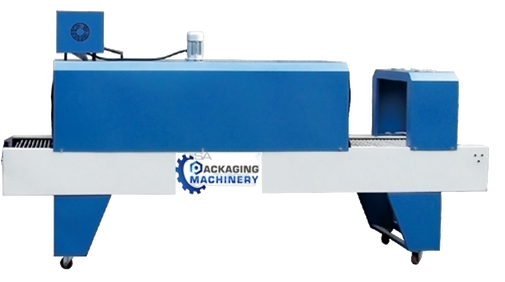
Machine Overview
| Machine type | Heat shrink tunnel |
| Pairs with | L-bar, side bar or sleeve sealer — any sealer that leaves the film unshrunk |
| Shrink method | Heated air circulation (electric); steam on request for sleeve labels |
| Shrink area | 550–900 mm wide across four models |
| Speed | 0–10 m/min belt, variable |
| Film | POF, PE or PVC |
| Automation | Standalone unit, or integrated in line with a sealer |
| Utilities | 380 V three-phase, 18–28 kW depending on model |
Configurations
A shrink tunnel is the second half of every shrink-wrap machine on this site: the sealer forms and seals the film, the tunnel is what actually shrinks it. Every L-bar, side bar and sleeve sealer we supply is paired with one of the four tunnels below, and a tunnel can also be bought on its own to pair with equipment you already have. What you choose comes down to heating method and how it sits in your line. If you are still deciding on the sealer itself, start at shrink wrap machines.

01
Heated air circulated around the pack by silica-tube elements and fans. The standard choice for general shrink wrapping in POF, PVC or PE, and what pairs with every L-bar, side bar and sleeve sealer we supply.
02
Controlled steam heat rather than hot air, giving a smoother, more even shrink with no film distortion. Built mainly for PET shrink sleeve labels on round or irregular containers rather than general packaging.

03
A tunnel can run on its own behind a manual or semi-automatic sealer, or be built into one continuous line with the sealer feeding it directly. Standalone costs less and is easy to relocate; integrated removes the handling step between seal and shrink.
04
Conveyor integration, dual-chamber configuration and extended tunnel length built to match your sealer and line layout, rather than a fixed off-the-shelf size.
Control features
A shrink tunnel is specified as much by its controls as its size. Getting temperature, airflow and belt speed right is what produces a tight, even shrink without burn marks, wrinkles or film that has not fully contracted.
Temperature is set to match the film type and thickness, and controlled air circulation directs heat evenly around the pack so every side shrinks at the same rate, even on unusual shapes.
Belt speed sets exposure time in the heated chamber. Slower speeds suit thicker film and larger products; faster speeds suit lightweight products and high-volume runs.

POF gives the clearest, highest-quality finish for food, cosmetics and retail. PE is thicker and stronger for heavier products and bulk packaging. PVC gives good clarity for general retail at a lower cost.
Airflow recovery and chamber insulation reduce heat loss during operation, which keeps running costs down on a machine that otherwise runs its heating elements continuously through a shift.
Applications
Household and cleaning. Retail and multipack presentation:
Industrial and consumer goods. Protection in transit:
Food and beverage. Shelf presentation and hygiene:
The guides below cover the machines this tunnel pairs with, and the buying questions we are asked about most.
Pairs with: L-bar sealer · side bar sealer · sleeve sealer
Choosing: how shrink wrap machines work · L-bar vs side sealer · L-bar vs sleeve sealer
Specifications
A shrink tunnel is specified by the pack it has to clear, not by the sealer ahead of it. Four sizes cover shrink chambers from 550 mm to 900 mm wide, each running at 0–10 m/min belt speed depending on the model.
Sizing the tunnel. The pack must clear the shrink chamber in width and height with room for the film to move as it shrinks. Match the tunnel to the sealer feeding it — an L-bar or sleeve sealer’s largest pack size sets the minimum chamber you need.
All four models take POF or PVC; the SAP-6040PE and SAP-9050PE also take PE. Heating is silica-tube in every model, with one fan on the smallest tunnel and two on the rest.
Belt speed runs 0–10 m/min depending on the model. Slower speeds hold the pack in the heat longer for thicker film or larger products; faster speeds suit lightweight packs at volume. Confirm the right setting on a trial with your film and product.
| Shrink tunnel | SAP-6040PE | SAP-7530PE | SAP-5530POF | SAP-9050PE |
|---|---|---|---|---|
| Shrink area width | 600 mm | 750 mm | 550 mm | 900 mm |
| Shrink area height | 400 mm | 300 mm | 300 mm | 500 mm |
| Shrink area length | 1800 mm | 1500 mm | 1500 mm | 1800 mm |
| Machine length | 3000 mm | 2000 mm | 2100 mm | 3000 mm |
| Fans | 1 | 2 | 2 | 2 |
| Belt speed | 0–6 m/min | 0–10 m/min | 0–10 m/min | 0–6 m/min |
| Power supply | 18 kW, 380 V | 18 kW, 380 V | 19.2 kW, 380 V | 28 kW, 380 V |
| Film | POF, PVC | PVC | PVC film | POF, PVC |
| Max conveying weight | 30 kg | 30 kg | 10 kg | — |
| Machine weight | 380 kg | 380 kg | 200 kg | 800 kg |
| Machine dimensions | 3000×760×1580 mm | 2000×980×1480 mm | 2100×850×1450 mm | 3000×1260×1880 mm |
All four models use silica-tube heating with roller conveying. Each pairs with a matching sealer: SAP-6040PE with our L-bar range, SAP-7530PE and SAP-5530POF with the L-bar, side bar and sleeve sealer ranges, and SAP-9050PE with our largest side bar and sleeve sealer models. CE and other industry certifications are available on request.
| Parameter | Specification |
|---|---|
| Heating | Silica-tube elements, electric (steam on request for sleeve labels) |
| Film | POF, PE or PVC depending on model |
| Conveying | Rollers, variable belt speed |
| Controls | Digital dual temperature control, adjustable airflow |
| Construction | Insulated chamber with airflow recovery to reduce energy loss |
| Automation | Standalone, or integrated in line with a sealer |
| Utilities | 380 V three-phase; 18–28 kW depending on model |
| Options | Custom conveyor integration, dual-chamber configuration, extended tunnel length |
Not sure which tunnel pairs with your sealer? Read how shrink wrap machines work, then send us your sealer and pack size for a trial.
About our modelModel codes shown are machines we have supplied and configured for previous projects. Your machine is specified and configured to suit your product, output and pack format — not supplied off the shelf.
About the machine
A shrink tunnel is a conveyor-based heating chamber that works downstream of a sealer, not a machine on its own. A sealer wraps and seals film around a product or bundle; the film stays loose until it passes through the tunnel, where heated air (or steam, on a sleeve-label tunnel) causes it to contract tight to the pack. For the machines it pairs with, see shrink wrap machines.
Temperature, airflow and belt speed are set to match the film type, thickness and product size, and held in the tunnel controls once tuned.
Upstream the tunnel is fed by an L-bar, side bar or sleeve sealer; downstream the finished pack goes to labelling, cartoning or despatch.
Read the full explanation in how shrink wrap machines work.
A tunnel shrinks whatever film the sealer ahead of it applies, across household, industrial and food packaging.
Typical uses are cleaning products and multipacks, automotive and hardware components, paint and lubricant containers, beverage multipacks, bottled water and bakery trays.
Every tunnel is sold matched to a sealer — see L-bar, side bar and sleeve sealer pages for the pairing that fits your pack.
Case Studies
A semi-automated line that added a tunnel ahead of automating fully, plus the comparisons we send to anyone choosing between electric and steam, or standalone and integrated.
“Highly recommended! Excellent customer service, great prices, and they always go above and beyond.”
Ratings and reviews are published on our Google Business Profile, where they can be read in full and in context.
PackMan purchased an Automatic 6-Lane, 4-Side Seal Vinegar Packaging Machine, and it has been performing reliably since installation. The machine delivers consistent packaging quality, operates efficiently, and has met our production expectations.

SA Packaging Machinery delivered a solution that has met our expectations. The equipment has been reliable in daily production, and we’re pleased with its performance. We found the team knowledgeable, professional, and willing to assist whenever required.
We’ve been very happy with the equipment supplied by SA Packaging Machinery. It’s straightforward to use, performs consistently, and has helped us improve our production process. The team was easy to work with and made the entire experience smooth.
Comparison
Both shrink film tight around the pack, but the heat source suits different jobs. Electric is the standard for general shrink wrapping; steam is built for the smooth finish a shrink sleeve label needs.
| Electric tunnel | Steam tunnel | |
|---|---|---|
| | |
| Heat source | Heated air circulation | Controlled steam distribution |
| Film | POF, PVC and PE | PET shrink sleeves and tamper bands |
| Best for | Cartons, boxes, trays, multipacks | Round or irregular containers |
| Finish | Standard shrink finish | Smooth, even, no wrinkling |
| Running cost | Lower | Higher |
| Typical industry | General retail and industrial | Beverage and cosmetic bottling |
Choose electric for general shrink wrapping across cartons, trays and multipacks; choose steam only where you are applying shrink sleeve labels to bottles or containers.
The other choice is how the tunnel sits in your line: on its own, or built into one continuous system with the sealer.
| Standalone tunnel | Integrated system | |
|---|---|---|
| | |
| Setup | Independent of the sealer | Sealer and tunnel run as one line |
| Investment | Lower initial cost | Higher, but removes a handling step |
| Flexibility | Relocates easily, fits existing lines | Fixed to the line it is built into |
| Automation level | Manual or semi-automatic | Automatic, continuous |
| Best for | Smaller operations, upgrades | Medium to high-volume production |
Advantages
The tunnel is what actually finishes a shrink-wrapped pack — without it, the sealer’s film stays loose and the packaging job is not done. Buying the tunnel matched to your sealer, sized to your largest pack and controlled for the right film, temperature and speed is what turns a sealed pack into a tight, tamper-evident, retail-ready one. Airflow recovery and chamber insulation keep running costs down on a machine that heats continuously through a shift, and digital controls make it repeatable from one production run to the next.
Choosing between electric and steam, or standalone and integrated, comes down to your film and your line — see the comparisons above, or send us your sealer and pack size for a recommendation.
Quotation
A shrink tunnel is quoted matched to the sealer and pack it needs to handle, so the quotation is built from your line rather than from a list price. To narrow the specification before you enquire, read how shrink wrap machines work; for what shapes the figure on any machine quotation, see the packaging machine cost guide. Send us your sealer and pack size and we will confirm the right tunnel and quote it.
Why us
Every shrink tunnel we supply is installed and commissioned on your floor, matched to its sealer, with operator training, a spare-parts holding in Johannesburg and technical support once the line is running.
Installation and commissioning.
We position the tunnel behind its sealer, connect the 380 V three-phase supply, tune temperature, airflow and belt speed against your own film and product, and hand over once the shrink is tight and even.
Operator training.
Your operators are trained on temperature and airflow settings, adjusting belt speed for different products, daily cleaning of the chamber and conveyor, and the wear items worth keeping on the shelf.
Service, spares and support.
Heating elements, fans, belts and conveyor rollers are held in Johannesburg, with service across South Africa and into neighbouring SADC markets. Routine care is set out in our packaging machine maintenance guide.
Choosing the right shrink tunnel comes down to five things:
You might also like
Browse the full range
Filling MachinesFlow WrapHorizontal Fill-SealHorizontal Form-Fill-SealCartoningCup Fill and SealTube Fill and SealLabellingShrink Sleeve LabellingShrink TunnelSleeve Sealer and Shrink TunnelL-Bar SealerSide Bar SealerBlister and ClamshellBottle Filler-Capper-LabellerCan Fill-Seam
SA Packaging Machinery supplies shrink tunnels matched to every sealer we sell, across South Africa and Southern Africa. Send us your sealer and pack size and we will confirm the right tunnel and quote it.
Questions
A shrink tunnel is a conveyor-based heating chamber that shrinks film tight around a product after a sealer has wrapped and sealed it. It works with a sealer — L-bar, side bar or sleeve — rather than on its own; the sealer forms the seal, the tunnel finishes the pack.
The sealer forms the pack; the tunnel makes it tight. A sealed pack straight off an L-bar, side bar or sleeve sealer is still loose — without the heat of the tunnel the film never contracts, so a tunnel is needed for any finished shrink-wrapped pack.
Electric tunnels (POF, PVC or PE) suit general shrink wrapping of cartons, boxes, trays and multipacks. Steam tunnels are built for PET shrink sleeve labels on bottles and containers, giving a smoother finish with no wrinkling.
Up to 10 m/min belt speed depending on the model. Slower speeds hold thicker film or larger products in the heat longer; faster speeds suit lightweight packs at volume. Real throughput is confirmed on a trial with your film and product.
Between 1 and 20 packs per minute depending on the model, the pack size and how quickly product is collated. A semi-automatic machine is paced by the operator; a fully automatic one by the line feeding it. Real output is confirmed on a trial.
From 550 mm wide on the SAP-5530POF up to 900 mm on the SAP-9050PE, with shrink chamber heights from 300 mm to 500 mm. The tunnel needs to clear whatever your sealer’s largest pack size is.
Buy a tunnel matched to the sealer feeding it. Our L-bar, side bar and sleeve sealer pages each list the tunnel that pairs with them; send us your sealer and pack size if you are buying the tunnel separately.
Routine care: clean the heating elements and chamber, check the conveyor and belt tracking, calibrate temperature controls, and inspect airflow systems and fans. The general schedule is in our packaging machine maintenance guide.