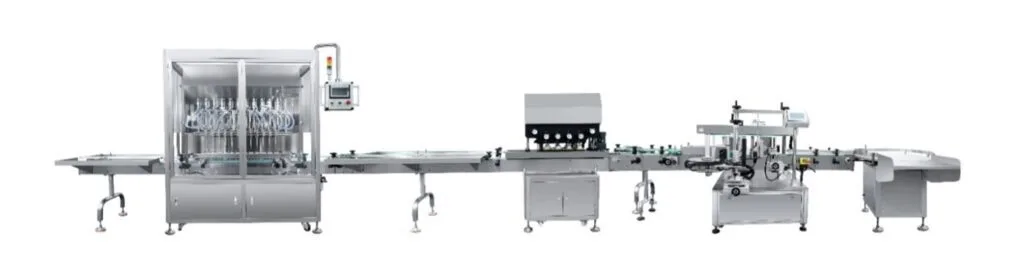
Machine Overview
| Machine type | Round bottle, double-sided or top-flat labeller |
| Products | Bottles, jars, pouches, tubes, boxes, containers and cans |
| Output | 10–200 pcs/min depending on model |
| Accuracy | ±0.2–1 mm depending on model |
| Label type | Self-adhesive, wrap-around and front-and-back labels |
| Automation | Semi-automatic or fully automatic |
| Bottle shapes | Round, flat, square, oval and irregular |
| Utilities | AC 220 V, compressed air 0.4–0.8 MPa |
Configurations
A labelling machine feeds the product past a label dispenser, presses the label on, and discharges it, either rotating the container for a wrap-around label or holding it flat for a front, back or top label. Which configuration you need comes down to container shape and label placement. If you are still deciding between machine types, start at our full machine range.

01
Rotates the container while applying the label, giving accurate positioning and a wrinkle-free wrap-around finish. Five models cover 20–200 pcs/min, fully automatic, with ±1 mm accuracy.

02
Applies labels to the front and back of flat, oval, rectangular or square containers in one pass, so branding, product information and regulatory details can sit on separate labels without a second station.
03
Applies labels to the upper surface of flat products, cartons, pouches, trays or lids. Simple, reliable operation and easy to integrate into an existing line, commonly used for date coding and product identification.
04
Any of the three label placements can be run semi-automatically, with an operator loading and removing product, or fully automatically as part of a continuous line. The choice is production volume, not label style.
Applications
Label placement is matched to the container and the industry it serves. These are the three sectors we supply into most.

Shampoo, lotion, perfume, skincare jars, cosmetic tubes, soap and personal care products, where label alignment and finish carry the brand.

Water, juice, sauce jars, spice containers, beverage packaging, honey jars and snack containers, where clear identification and retail-ready presentation both matter.

Cleaning chemicals, industrial containers, lubricant bottles, automotive products, detergent packaging and agricultural chemicals, where the label has to hold up as well as the product inside.

Bottle unscramblers, custom cap and label feeders, batch coders, automatic inspection systems and integration with downstream shrink wrap or cartoning, built into the line rather than added as an afterthought.
Applications
Cosmetics and toiletries. Accurate, professional branding:
Food and beverage. Clear identification, retail-ready:
Chemical and industrial. Durable, accurate labelling:
The guides below cover the buying and running questions we are asked about most for labelling machines.
Choosing: how to choose a labelling machine · label applicator vs labelling machine · guide to labelling machines
Cost and care: labelling machine cost · labelling machine ROI · maintenance guide · troubleshooting guide
By label type: wrap-around labelling · front and back labelling
Specifications
A labelling machine is specified by container shape and label placement first, output second. Twelve models split across round-bottle and flat-surface/double-sided ranges, running semi-automatic through to fully automatic.
Sizing the machine. Round containers need a wrap-around round-bottle labeller; flat, square or oval containers need a flat-surface or double-sided model. Product and label dimensions are customisable on every model, so start from your target output and accuracy requirement.
Accuracy runs from ±0.2 mm on the tightest semi-automatic flat-surface model to ±1 mm on the general-purpose models. All run on AC 220 V; models needing compressed air run at 0.4–0.8 MPa.
Output ranges from 10 pcs/min on the smallest semi-automatic models up to 200 pcs/min on the fastest round-bottle machine. Real speeds are confirmed on a trial with your product and label.
| Model | Application | Automation | Accuracy | Speed | Power | Weight | Dimensions |
|---|---|---|---|---|---|---|---|
| 301 | Round Bottle | Fully | ±1mm | 60-150 pcs/min | AC220V 530W | 185kg | 2000×1100×1300mm |
| SAP-301Z | Round Bottle | Fully | ±1mm | 10-40 pcs/min | AC220V 200W | 55kg | 1300×1000×600mm |
| 302 | Round Bottle | Fully | ±1mm | 20-60 pcs/min | AC220V 600W | 185kg | 2000×1100×1300mm |
| SAP-302Z | Round Bottle | Fully | ±1mm | 10-30 pcs/min | AC220V 200W | 55kg | 1300×1100×600mm |
| 305 | Round Bottle | Fully | ±1mm | 20-200 pcs/min | AC220V 530W | 240kg | 2050×650×1450mm |
| 311 | Round Bottle | Semi | ±0.5mm | 20-40 pcs/min | AC220V 200W | 33kg | 920×550×520mm |
| Model | Application | Automation | Accuracy | Speed | Power | Weight | Dimensions |
|---|---|---|---|---|---|---|---|
| 601 | Flat Surface | Fully | ±1mm | 60-120 pcs/min | AC220V 501W | 180kg | 1600×780×1400mm |
| 601Z | Flat Surface | Fully | ±1mm | 20-80 pcs/min | AC220V 200W | 110kg | 1100×800×650mm |
| 612 | Flat Surface | Semi | ±0.2mm | 15-30 pcs/min | AC220V 150W | 67kg | 550×450×1000mm |
| 615H | Flat Surface | Semi | ±1mm | 15-25 pcs/min | AC220V 145W | 60kg | 1000×650×850mm |
| SAP-616 | Square/Flat/Round/Oval/Irregular | Semi | ±0.5mm | 15-35 pcs/min | AC220V 145W | 60kg | 1000×650×850mm |
| 902 | Double-Sided Bottle | Fully | ±1mm | 30-150 pcs/min | AC220V 1.1kW | 330kg | 3000×1450×1600mm |
Product and label dimensions are customisable across every model. Air pressure is 0.4–0.8 MPa where compressed air is required. CE certificates are available on request.
| Parameter | Specification |
|---|---|
| Label types | Self-adhesive, wrap-around, front-and-back and tamper-evident |
| Container shapes | Round, flat, square, oval and irregular |
| Automation | Semi-automatic or fully automatic |
| Integrations | Conveyor systems, servo motors, date coding, vision inspection, bottle orientation |
| Utilities | AC 220 V single-phase; compressed air 0.4–0.8 MPa where required |
| Options | Round-bottle attachment upgrade on double-sided models, custom label sizing, batch coding |
| Integration | Filling, capping and downstream packaging equipment |
Not sure which labeller suits your container? Read how to choose a labelling machine, then send us your product and label for a trial.
About our modelModel codes shown are machines we have built or configured for previous projects. Your machine is specified and built to suit your product, output and pack format — not supplied off the shelf.
About the machine
A labelling machine feeds the product onto a conveyor, a sensor detects its position, and the PLC dispenses a label from a reel and presses it on at controlled tension and speed — rotating the container for a wrap-around label, or holding it flat for a front, back or top label. For the buying decision in full, read the how to choose a labelling machine guide.
Label tension, application speed and position are set per product and held in the machine controls, so a changeover between products is a settings change rather than a rebuild.
Upstream the product arrives from filling and capping; downstream it feeds shrink wrap, cartoning or case packing.
Read the full explanation in the guide to labelling machines.

Label placement is matched to container shape, so the same underlying machine design covers round bottles through to flat cartons.
Typical products are shampoo, lotion and perfume bottles; water, juice and sauce containers; and cleaning chemicals, lubricants and industrial containers.
For labels that shrink onto the container rather than adhering to it, see our shrink sleeve labeller. For a filled and capped bottle before labelling, see bottle filler-capper-labeller.
Case Studies
A double-sided bucket labeller with thermal printing and a dual-function bottle labeller, plus the comparisons we send to anyone weighing up round bottle against double-sided against top-flat.
“Highly recommended! Excellent customer service, great prices, and they always go above and beyond.”
Ratings and reviews are published on our Google Business Profile, where they can be read in full and in context.
PackMan purchased an Automatic 6-Lane, 4-Side Seal Vinegar Packaging Machine, and it has been performing reliably since installation. The machine delivers consistent packaging quality, operates efficiently, and has met our production expectations.

SA Packaging Machinery delivered a solution that has met our expectations. The equipment has been reliable in daily production, and we’re pleased with its performance. We found the team knowledgeable, professional, and willing to assist whenever required.
We’ve been very happy with the equipment supplied by SA Packaging Machinery. It’s straightforward to use, performs consistently, and has helped us improve our production process. The team was easy to work with and made the entire experience smooth.
Comparison
Container shape and label placement decide which of the three you need. All three run semi-automatic or fully automatic models.
| Round bottle | Double-sided | Top flat | |
|---|---|---|---|
| | | |
| Best for | Cylindrical bottles, jars, tubes, cans | Flat, oval, rectangular, square containers | Cartons, pouches, trays, lids |
| Label style | Wrap-around | Front and back, single pass | Top surface |
| Accuracy | ±0.5-1 mm | ±1 mm | ±0.2-1 mm |
| Speed range | 20-200 pcs/min | 30-150 pcs/min | 15-120 pcs/min |
| Typical use | Water, beverage, pharma bottles | Detergent, cosmetic, oil containers | Date coding, product ID |
Choose round bottle for cylindrical containers, double-sided when you need front and back information in one pass, and top flat for cartons and pouches. Some double-sided models can be upgraded with a round-bottle attachment.
The other choice is automation level, which sets speed, labour and entry price rather than which label style you can run.
| Semi-automatic | Fully automatic | |
|---|---|---|
| | |
| Operator input | Loads and removes each product | Minimal — supervision only |
| Speed | Lower, operator-paced | Higher, continuous |
| Investment | Lower entry cost | Higher |
| Footprint | Compact | Larger, line-integrated |
| Best for | Small businesses, start-ups, pilot runs | Medium to large manufacturers, multi-shift |
Container shape is the first decision in specifying a labelling machine, since it decides the labelling method more than any other factor.
| Round bottles | Flat / square bottles | |
|---|---|---|
| | |
| Labelling method | Wrap-around, rotational handling | Front-and-back or multi-panel |
| Typical use | Water, juice, cosmetic, pharma, chemical | Cleaning products, detergents, personal care, lubricants |
| Key requirement | Consistent label tension control | Precise front-and-back alignment |
| Recommended machine | Round bottle labeller | Double-sided labeller |
Advantages
Manual labelling is slow and inconsistent at any real volume, and a crooked or bubbled label undercuts branding as much as a good product deserves better. An automated labeller holds tension, position and speed consistent across a full run, and because label placement and automation level are chosen independently, the same underlying machine design scales from a start-up’s first semi-automatic unit to a fully integrated line running 200 bottles a minute.
For the finished container, see our sleeve sealer for multipack bundling or shrink sleeve labelling for a full-body shrink label instead of adhesive.
Quotation
A labelling machine is quoted to your container, label and target output, so the quotation is built from a trial run rather than a list price. To narrow the specification before you enquire, read how to choose a labelling machine; for what shapes the figure on any machine quotation, see the labelling machine cost guide. Send us your product and label and we will trial it and quote the configuration that suits it.
Why us
Every labelling machine we supply is installed and commissioned on your floor, with operator training, a spare-parts holding in Johannesburg and technical support once you are running.
Installation and commissioning.
We position the machine, connect the electrical supply and compressed air where required, set label tension, position and application speed against your own product and label, and hand over once labels are applying consistently.
Operator training.
Your operators are trained on reel loading and tracking, adjusting for different container sizes, calibrating label position, PLC operation, and the wear items worth keeping on the shelf.
Service, spares and support.
Applicator wheels, sensors, reel spindles and drive components are held in Johannesburg, with service across South Africa and into neighbouring SADC markets. Routine care is set out in our labelling machine maintenance guide, and common faults are covered in our troubleshooting guide.
Choosing the right labelling machine comes down to five things:
You might also like
SA Packaging Machinery supplies labelling machines across South Africa and Southern Africa. Send us your product and label and we will trial it, recommend the configuration, and quote it.
Questions
An automatic or semi-automatic system that applies pre-printed self-adhesive labels to products, containers or packages, feeding the product past a label dispenser and pressing the label on at controlled position and tension.
Bottles, jars, pouches, tubes, boxes, containers and cans across food and beverage, pharmaceutical, cosmetic, chemical and industrial applications. Container shape and label placement decide which configuration suits your product.
Round, flat, square, oval and irregular bottles and containers. Round containers use a round-bottle labeller for wrap-around labels; flat, square or oval containers use a double-sided or top-flat labeller.
Self-adhesive, wrap-around, front-and-back and tamper-evident labels. The machine and its applicator wheel are matched to your label material and size, which are customisable across every model.
Between 10 and 200 pieces per minute depending on the model and automation level. Semi-automatic machines are paced by the operator; fully automatic models sustain the top of the range. Real output is confirmed on a trial.
Accuracy runs from ±0.2 mm on the tightest semi-automatic model to ±1 mm on the general-purpose models. Product and label dimensions are customisable, so the limiting factor is usually your container shape rather than size.
Choose by container shape first — round bottle, double-sided or top-flat — then by volume: semi-automatic for smaller runs and start-ups, fully automatic for continuous high-volume lines. Our buying guide covers the decision in full.
Routine care: clean the applicator wheel and sensors, check reel tracking and tension, inspect drive belts and rollers, and calibrate label position. Full schedules and common fixes are in our maintenance guide and troubleshooting guide.