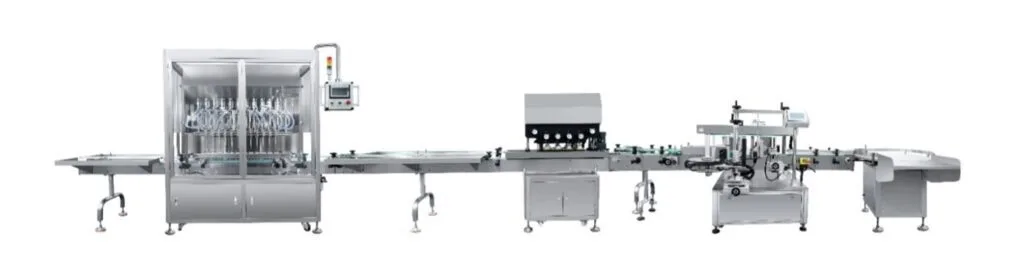
Machine Overview
| Machine type | Shrink sleeve applicator with heat tunnel |
| Products | Bottles, jars, cans, glass and PET containers |
| Output | 100–1000 pcs/hour |
| Coverage | 360-degree full-body or half-body sleeve |
| Working temperature | 100–150°C |
| Heating | Electric or steam tunnel |
| Sleeve types | Full body, half body, tamper-evident band |
| Utilities | 380 V three-phase, 0–50 kW depending on model |
Configurations
A shrink sleeve labeller feeds a printed PVC or PET sleeve over the container, cuts it to length, and passes it through a heat tunnel where the sleeve shrinks tight to the product shape. Two models cover the range, and the choice between an electric and a steam tunnel is the main configuration decision. If you are still deciding between shrink sleeve and self-adhesive labels, see the comparison below.

01
Working temperature 100°C, up to 36 kW. The entry model for standard bottle and jar diameters at 100–1000 pieces per hour.
02
Working temperature 100–150°C, up to 50 kW. The wider-diameter model, built for larger containers and higher-temperature sleeve materials.

03
A narrower sleeve applied only at the cap or neck, giving visible tamper evidence without the cost of a full-body sleeve. Commonly added to a filled and capped container as the final security step.
04
Both machines pair with either an electric or a steam tunnel. Electric uses hot air circulation and is the simpler, lower-maintenance choice; steam gives a more even shrink on curved or irregular containers. See the full comparison below.
Applications
Shrink sleeve coverage and sleeve type are matched to the product and the branding job it needs to do. These are the three areas we supply into most.
Soft drink, juice and water bottles, energy drinks and food jars, where 360-degree coverage and tamper evidence both matter on the shelf.
Pharmaceutical containers, cosmetic and personal care products, where tamper-evident bands and premium shelf presentation are both required.
Beverage can multipacks, promotional bundles and retail multipacks, where a sleeve groups the branding across several units into one shelf-ready package.

Cleaning products, detergents and household chemical containers, where a full-body sleeve holds up to handling and washing better than a flat label.
Applications
Beverage and food. Full coverage and tamper evidence:
Pharmaceutical and cosmetic. Tamper evidence and presentation:
Multipack and promotional. Retail shelf impact:
The guide below covers the choice most customers ask about before buying a shrink sleeve labeller.
Choosing: shrink sleeve vs pressure-sensitive labels · self-adhesive labelling machines
Specifications
A shrink sleeve labeller is specified by container diameter and tunnel type, not by a single size. Two models cover the diameter range, both running 100–1000 pieces per hour.
Sizing the machine. The SAP-ZS2030C suits standard bottle and jar diameters at up to 100°C; the SAP-ZS2535 takes a wider diameter range and runs up to 150°C for more demanding sleeve film. Tunnel choice (electric or steam) is independent of the model.
Both models run PVC or PET shrink sleeve film and can be paired with either tunnel type. Steam-tunnel configurations need a water supply at 40 L/H.
Output runs 100–1000 pieces per hour on both models; real throughput depends on container size and sleeve length. Confirm on a trial with your container and sleeve.
| Model | SAP-ZS2030C | SAP-ZS2535 |
|---|---|---|
| Machine capacity | 100–1000 pcs/Hour | 100–1000 pcs/Hour |
| Working temperature | 100°C | 100–150°C |
| Working pressure | Normal pressure | Normal pressure |
| Water consumption | 40 L/H | 40 L/H |
| Power supply | 380V 50Hz 0–36kW | 380V 50Hz 0–50kW |
| Machine weight | 500 kg | 500 kg |
| Dimensions (L×W×H) | 3000×700×1900 mm | 3000×850×1900 mm |
Water consumption applies to steam-tunnel configurations. CE certificates are available on request.
| Parameter | Specification |
|---|---|
| Sleeve types | Full body, half body, tamper-evident band |
| Coverage | 360-degree, full-body or half-body |
| Container types | Bottles, jars, cans, glass and PET containers |
| Tunnel | Electric or steam, matched to the sleeve material and container shape |
| Controls | Touchscreen operation, automated cycle |
| Utilities | 380 V three-phase; water supply required for steam-tunnel models |
| Options | Tamper-evident band applicator, custom sleeve widths, integration with filling and labelling lines |
Not sure whether shrink sleeve or self-adhesive suits your product? Read shrink sleeve vs pressure-sensitive labels, then send us your container for a trial.
About our modelModel codes shown are machines we have built or configured for previous projects. Your machine is specified and built to suit your product, output and pack format — not supplied off the shelf.
About the machine
A shrink sleeve labeller feeds printed PVC or PET sleeve film over the container, cuts it to length, and passes the sleeved product through a heat tunnel where the film shrinks tight to the container shape. Unlike a self-adhesive label, the finished sleeve covers the full circumference of the container in one continuous piece.
Sleeve length, cut position and tunnel temperature are set per container and held in the machine controls, so a changeover between products is a settings change.
Upstream the container arrives from filling and capping; downstream it feeds cartoning, case packing or a multipack sleeve sealer.
For the choice between shrink sleeve and self-adhesive labels, read shrink sleeve vs pressure-sensitive labels.
Shrink sleeves suit any container needing full-circumference branding or tamper evidence, wherever a flat self-adhesive label would not follow the container shape.
Typical products are beverage and food bottles, pharmaceutical and cosmetic containers, and can and bottle multipacks.
For a flat, front-and-back or wrap-around adhesive label instead, see our labelling machine page.
Comparison
Both shrink sleeve and self-adhesive labels are widely used across food, beverage, cosmetic and pharmaceutical products. They differ significantly in coverage, appearance and equipment.
| Shrink sleeve | Self-adhesive | |
|---|---|---|
|  | |
| Coverage | 360-degree, full body | Front, back, wrap-around or top |
| Container fit | Conforms to complex shapes | Flat or gently curved surfaces |
| Tamper evidence | Built in as standard | Requires a separate tamper band |
| Equipment cost | Higher, needs a heat tunnel | Lower, no tunnel required |
| Changeovers | Slower, sleeve and tunnel settings | Fast, reel swap only |
| Best for | Premium branding, irregular shapes | Standard bottles, fast changeovers |
Choose shrink sleeve for 360-degree branding, tamper evidence or complex container shapes; choose self-adhesive for standard bottles, lower equipment cost and fast changeovers.
Once the sleeve is on, it still needs to shrink tight. Tunnel choice decides how even that finish is, and what containers it suits.
| Electric tunnel | Steam tunnel | |
|---|---|---|
| | |
| Heat method | Hot air circulation | Directed steam |
| Best for | Straight-sided, standard shapes | Curved or contoured containers |
| Finish | Good, standard result | Superior, even shrink with no distortion |
| Installation | Simple, no steam plant needed | Needs water supply and steam infrastructure |
| Maintenance | Lower | Higher |
| Typical use | Small to medium volumes | Premium packaging, high volumes |
Guides
No case studies exist for this machine yet — here are the guides we send to anyone choosing between shrink sleeve, self-adhesive labelling, and tunnel type.
“Highly recommended! Excellent customer service, great prices, and they always go above and beyond.”
Ratings and reviews are published on our Google Business Profile, where they can be read in full and in context.
PackMan purchased an Automatic 6-Lane, 4-Side Seal Vinegar Packaging Machine, and it has been performing reliably since installation. The machine delivers consistent packaging quality, operates efficiently, and has met our production expectations.

SA Packaging Machinery delivered a solution that has met our expectations. The equipment has been reliable in daily production, and we’re pleased with its performance. We found the team knowledgeable, professional, and willing to assist whenever required.
We’ve been very happy with the equipment supplied by SA Packaging Machinery. It’s straightforward to use, performs consistently, and has helped us improve our production process. The team was easy to work with and made the entire experience smooth.
Advantages
A shrink sleeve is the only label format that covers a container completely, so it carries more branding, more compliance information, and tamper evidence as standard, all in one application. Because the sleeve conforms to the container as it shrinks, it works on shapes a flat label cannot follow, which is why premium beverage and cosmetic brands default to it for shelf-facing products.
For containers where a flat or wrap-around label is enough, our labelling machine page covers the lower-cost self-adhesive route.
Quotation
A shrink sleeve labeller is quoted to your container and sleeve, so the quotation is built from a trial run rather than a list price. To narrow the specification before you enquire, read shrink sleeve vs pressure-sensitive labels. Send us your container and we will trial it and quote the configuration that suits it.
Why us
Every shrink sleeve labeller we supply is installed and commissioned on your floor, with operator training, a spare-parts holding in Johannesburg and technical support once you are running.
Installation and commissioning.
We position the applicator and tunnel, connect the 380 V supply and water where a steam tunnel is fitted, set sleeve length, cut position and tunnel temperature against your own container, and hand over once the shrink is tight and even.
Operator training.
Your operators are trained on sleeve reel loading, cut-length adjustment, tunnel temperature settings, touchscreen operation, and the wear items worth keeping on the shelf.
Service, spares and support.
Cutting blades, applicator mandrels, heating elements and tunnel components are held in Johannesburg, with service across South Africa and into neighbouring SADC markets.
Choosing the right shrink sleeve configuration comes down to five things:
You might also like
SA Packaging Machinery supplies shrink sleeve labelling machines across South Africa and Southern Africa. Send us your container and we will trial it, recommend the configuration, and quote it.
Questions
An automated system that applies a printed shrink sleeve around a container and shrinks it tight in a heat tunnel, giving full 360-degree coverage in one continuous piece rather than a flat adhesive label.
Bottles, jars, cans, glass and PET containers across beverage, food, pharmaceutical and cosmetic products. Full body, half body and tamper-evident band sleeves are all supported.
Round, oval and irregularly shaped containers work well, since the sleeve conforms to the container as it shrinks. The SAP-ZS2030C and SAP-ZS2535 cover different diameter ranges.
PVC and PET shrink sleeve film, run through either an electric or a steam tunnel depending on the container shape and finish required.
Both models run 100–1000 pieces per hour; real output depends on container size and sleeve length. Confirm real speeds on a trial with your container.
Choose electric for standard bottle shapes and lower equipment cost; choose steam for curved or premium containers where an even, distortion-free shrink matters most. See our electric vs steam comparison for more.
Shrink sleeve gives 360-degree coverage and built-in tamper evidence; self-adhesive is lower cost with faster changeovers. Our full comparison covers the decision.
Routine care: clean the sleeve cutting blade and applicator, check reel tracking, inspect tunnel heating elements and, on steam models, check the water supply and steam lines.