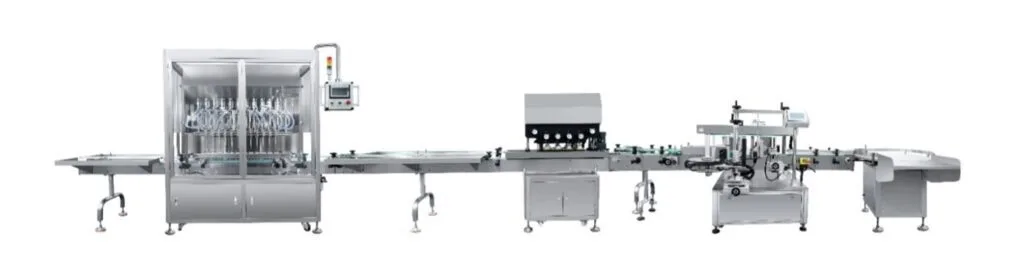
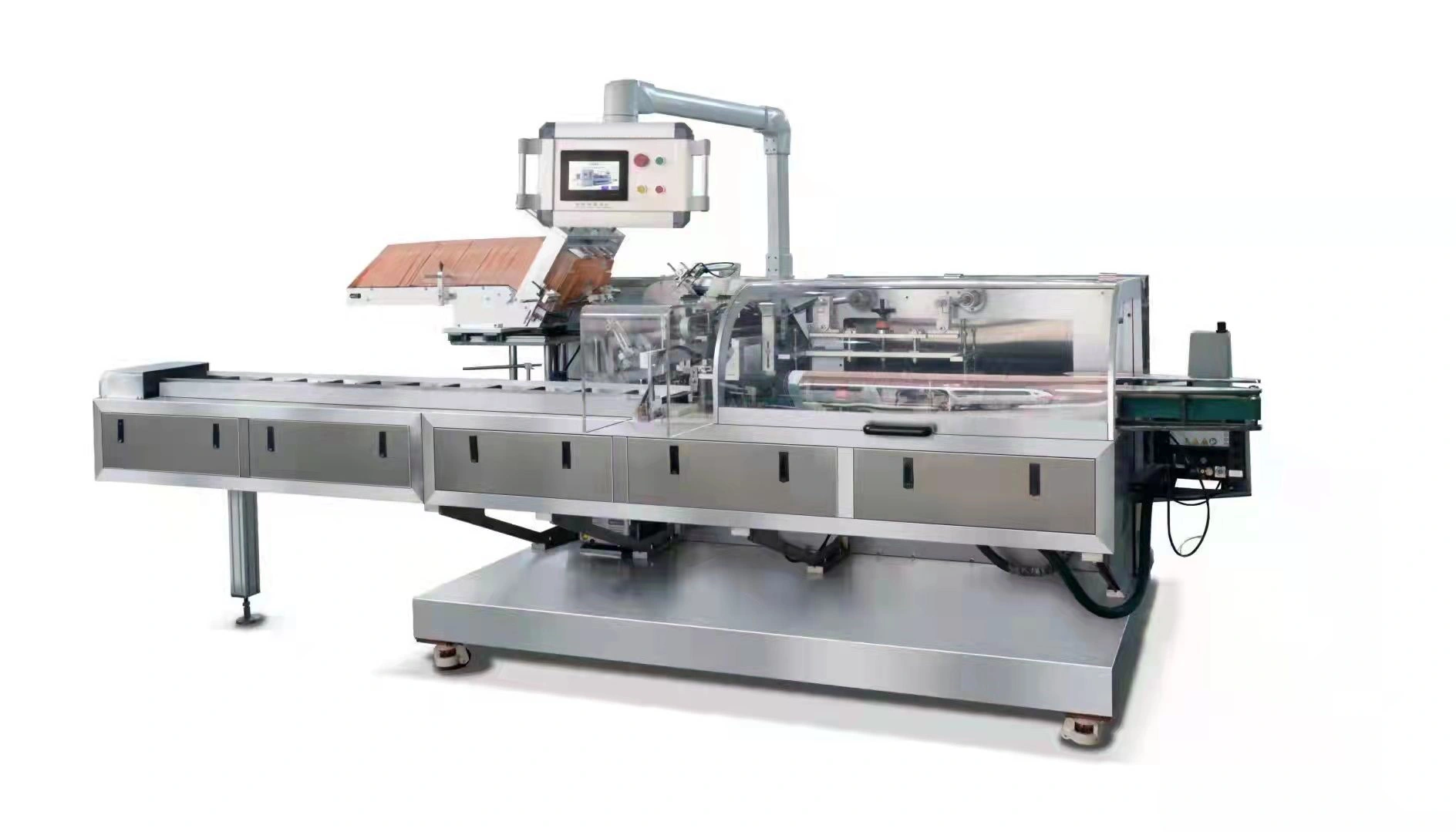
Machine Overview
| Machine type | Carton erector, loader, closer and sealer |
| Products | Individual products, multipacks, retail-ready and shipping cartons |
| Output | 30–300 boxes/min depending on model |
| Sealing | Hot-melt (Nordson) gluing or tuck folding |
| Motion | Intermittent or continuous |
| Automation | Semi-automatic or fully automatic |
| Utilities | 380 V three-phase, compressed air 0.6–0.8 MPa |
Configurations
A cartoning machine erects a flat carton blank, loads the product, closes the flaps and seals them shut, turning flat board into a retail-ready box. Nine models cover output from 30 to 300 boxes a minute, and two decisions shape which one you need: automation level and carton motion. If you are still deciding between motion types, see the comparison below.
Carton erection, product loading, closing and discharge run with minimal operator input. The standard choice for continuous food, pharmaceutical and consumer goods lines.
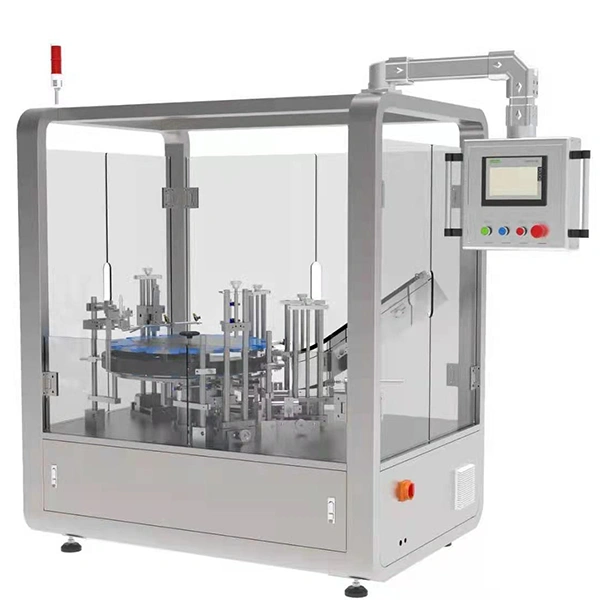
An operator loads product or cartons at one or more stations while the machine handles erection, closing and sealing. The lower-cost entry point for start-ups and multi-format runs.
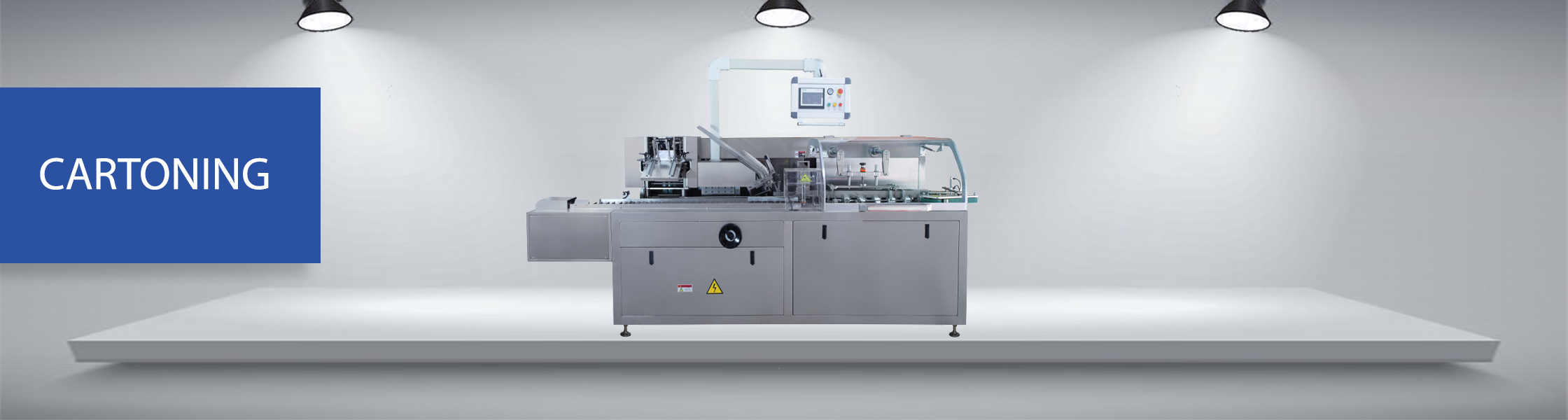
Cartons stop at each station for loading and closing. Easier changeovers and reliable handling of delicate or irregularly shaped products, at moderate production volumes.
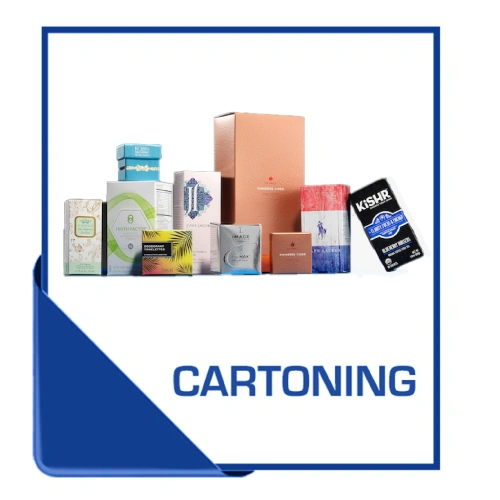
Cartons move constantly through the line with no stop-start cycle, giving the highest throughput. Built for large-scale, high-speed manufacturing.
Applications
Carton type and sealing method are matched to the product and the industry it ships in. These are the areas we supply into most.
Cereals, biscuits, snacks, tea, frozen and dairy products and confectionery, where secondary packaging protects the product and carries the branding.

Blister packs, injection medicines and bottled products, where leaflet insertion, batch coding and vision inspection are as important as the fold itself.
Household cleaners, automotive chemicals, lubricants, agricultural and industrial products, where the carton protects through storage and distribution.
Electronics, toys, personal care and household products, where retail shelf appeal and secure transport both matter.
Applications
Food and beverage. Retail-ready protection:
Pharmaceutical and cosmetic. Compliance and traceability:
Chemical and industrial. Storage and transport protection:
The guide below covers a question we’re asked often when a customer is deciding between cartons and shrink wrap for transport packaging.
Choosing: shrink wrap vs cartons for transport
Specifications
A cartoning machine is specified by output and sealing type first, product fit second. Nine models cover 30 to 300 boxes a minute, sealed by hot-melt gluing or fold closure.
Sizing the machine. Match target output to a model, then confirm your box size and sealing preference. Several models are built for specific applications — blisters (125B), injection medicines (125K), bottles (125P) — while others suit a general product range.
Nordson hot-melt gluing gives a permanent seal; folding or gluing configurations offer flexibility across pack types. Air pressure is 0.6–0.8 MPa across every model.
Output ranges from 30 boxes/min on the smallest models up to 300 on the SAP-300. Real speeds are confirmed on a trial with your carton and product.
| Model | SAP-120S | SAP-125B | SAP-125G | SAP-125K | SAP-125P | SAP-130 | SAP-150 | SAP-200 | SAP-300 |
|---|---|---|---|---|---|---|---|---|---|
| Application | Various products | Blisters | Various products | Injection medicines | Bottles | Various products | Various products | Various products | Various products |
| Power (380V 50Hz) | 7kW | 1.5kW | 1.5kW | 1.5kW | 1.5kW | 1.5kW | 8.5kW | 8.5kW | 10.5kW |
| Air consumption (L/min) | 15-20 | 20-30 | 20-30 | 20-30 | 20-30 | 20-30 | 15-20 | 15-20 | 15-20 |
| Output (boxes/min) | 30-100 | 30-100 | 30-85 | 30-85 | 30-100 | 30-130 | 50-150 | 50-180 | 100-180 |
| Sealing type | Nordson gluing | Folding or gluing | Folding or gluing | Folding or gluing | Folding or gluing | Folding or gluing | Nordson gluing | Nordson gluing | Nordson gluing |
Air pressure is 0.6–0.8 MPa across every model. Machine dimensions and box-size compatibility vary by model — contact us to confirm your box size against the right model. CE certificates are available on request.
| Parameter | Specification |
|---|---|
| Carton motion | Intermittent or continuous, depending on model and speed |
| Sealing method | Hot-melt (Nordson) gluing or tuck-fold closure |
| Features | Servo controls, vision inspection, automatic feeding, barcode verification |
| Automation | Semi-automatic or fully automatic |
| Utilities | 380 V three-phase; compressed air 0.6–0.8 MPa |
| Options | Leaflet insertion, carton coding, vision inspection, line integration |
Not sure which model fits your box size? Contact us to confirm compatibility, then send us your product for a trial.
About our modelModel codes shown are machines we have built or configured for previous projects. Your machine is specified and built to suit your product, output and pack format — not supplied off the shelf.
About the machine
A cartoning machine erects a flat carton blank into a box, loads the product through the open side, closes the flaps, and seals them shut with hot-melt glue or a tuck closure — turning flat board into a retail-ready box at up to 300 cartons a minute.
Carton size, glue pattern and closure settings are set per product and held in the machine controls, so a changeover between box sizes is a settings adjustment.
Upstream the product arrives from filling, labelling or bundling; downstream the sealed carton feeds case packing or palletising.
For the choice between cartons and shrink wrap for transport, read our shrink wrap vs cartons comparison.
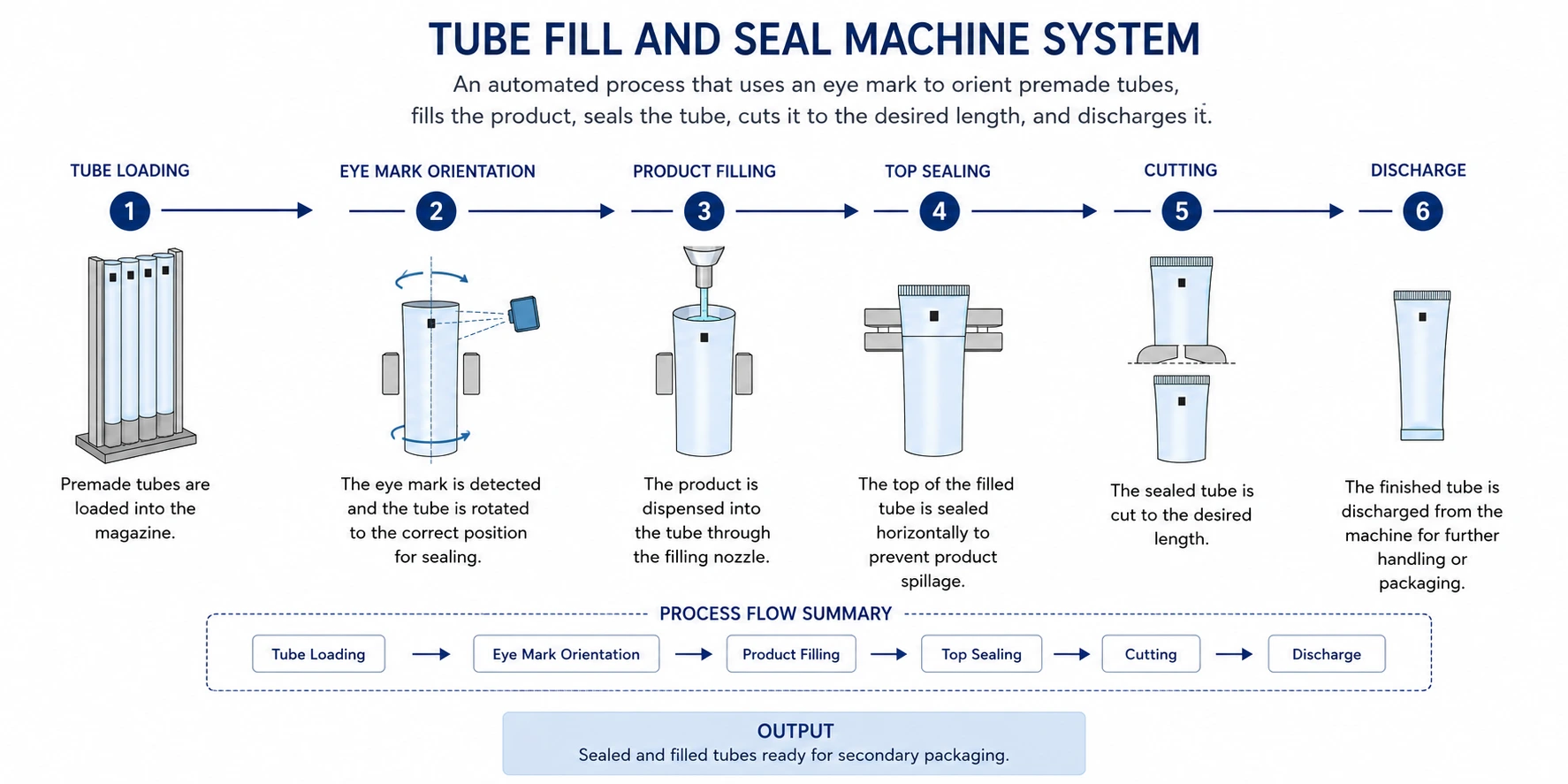
Cartoning suits any product needing secondary packaging for protection, branding or retail presentation.
Typical products are food and beverage cartons, pharmaceutical and cosmetic packs, and chemical and consumer goods cartons.
For the primary pack before cartoning, see our bottle filler-capper-labeller and tube fill and seal pages.
Comparison
Both erect, load and seal cartons; the difference is how much of the cycle the operator handles and the production volume each is built for.
| Automatic | Semi-automatic | |
|---|---|---|
| | |
| Operation | Erection, loading, closing and discharge automatic | Operator loads product or cartons by hand |
| Speed | Higher, continuous | Lower, operator-paced |
| Investment | Higher | Lower entry cost |
| Best for | Medium to large manufacturers, continuous lines | Start-ups, contract packers, multi-format runs |
Choose automatic for continuous, high-volume production; choose semi-automatic for lower volumes, frequent format changes, or a lower entry cost.
The other choice is how the carton moves through the machine, which decides top speed and how well it handles delicate or irregular products.
| Intermittent motion | Continuous motion | |
|---|---|---|
| | |
| Movement | Stop-and-start, pausing at each station | Constant movement through the cycle |
| Speed | Moderate | Highest, maximum throughput |
| Changeovers | Easier, more flexible | Less flexible, optimised for one format |
| Best for | Delicate or irregular products, multiple formats | Large-scale, high-speed manufacturing |
Guides
No case studies exist for this machine yet — here are the guides we send to anyone choosing a cartoning configuration.
“Highly recommended! Excellent customer service, great prices, and they always go above and beyond.”
Ratings and reviews are published on our Google Business Profile, where they can be read in full and in context.
PackMan purchased an Automatic 6-Lane, 4-Side Seal Vinegar Packaging Machine, and it has been performing reliably since installation. The machine delivers consistent packaging quality, operates efficiently, and has met our production expectations.
SA Packaging Machinery delivered a solution that has met our expectations. The equipment has been reliable in daily production, and we’re pleased with its performance. We found the team knowledgeable, professional, and willing to assist whenever required.

We’ve been very happy with the equipment supplied by SA Packaging Machinery. It’s straightforward to use, performs consistently, and has helped us improve our production process. The team was easy to work with and made the entire experience smooth.

Advantages
A carton is often the only branding surface a customer sees on the shelf, and the only protection a product has in transit, which is why getting the fold, seal and finish right matters as much as the filling stage before it. Because automation level and carton motion are chosen independently, the same underlying machine design scales from a start-up’s first semi-automatic cartoner to a continuous-motion line running 300 boxes a minute.
For the primary pack before cartoning, see our bottle filler-capper-labeller and tube fill and seal pages.
Quotation
A cartoning machine is quoted to your product, carton and target output, so the quotation is built from a trial run rather than a list price. Send us your product and carton and we will confirm the right model and quote it.
Why us
Every cartoning machine we supply is installed and commissioned on your floor, with operator training, a spare-parts holding in Johannesburg and technical support once you are running.
Installation and commissioning.
We position the machine, connect the electrical and compressed air supply, set carton size, glue pattern and closure settings against your own product, and hand over once cartons are erecting and sealing consistently.
Operator training.
Your operators are trained on carton loading, size changeovers, glue and seal settings, and the wear items worth keeping on the shelf.
Service, spares and support.
Glue guns, erection tooling and sensors are held in Johannesburg, with service across South Africa and into neighbouring SADC markets.
Choosing the right cartoning configuration comes down to five things:
You might also like
SA Packaging Machinery supplies cartoning machines across South Africa and Southern Africa. Send us your product and carton and we will confirm the right model, recommend the configuration, and quote it.
Questions
An automated system that erects a flat carton blank, loads the product, closes the flaps and seals them with hot-melt glue or a tuck closure — turning flat board into a retail-ready box.
Cereals, biscuits, snacks and frozen foods; blister packs, injection medicines and bottled pharmaceuticals; household chemicals and lubricants; and electronics, toys and personal care products.
Nordson hot-melt gluing gives a permanent seal; folding or gluing configurations offer flexibility across pack types, chosen by model to suit your product and carton.
Intermittent motion pauses at each station, giving easier changeovers and reliable handling of delicate or irregular products. Continuous motion runs without stopping, for the highest throughput on a fixed format.
Output ranges from 30 boxes per minute on the smallest models up to 300 on the SAP-300. Real speeds are confirmed on a trial with your carton and product.
Choose automatic for continuous, high-volume production; choose semi-automatic for lower volumes or a lower entry cost. Several models are also built for specific applications — blisters, injection medicines or bottles.
Yes. Leaflet insertion, vision inspection, carton coding and line integration with filling or labelling equipment can all be added to suit your application.
Routine care: clean glue guns and nozzles, check erection tooling and sensors, inspect belts and folding mechanisms, and calibrate carton size settings.