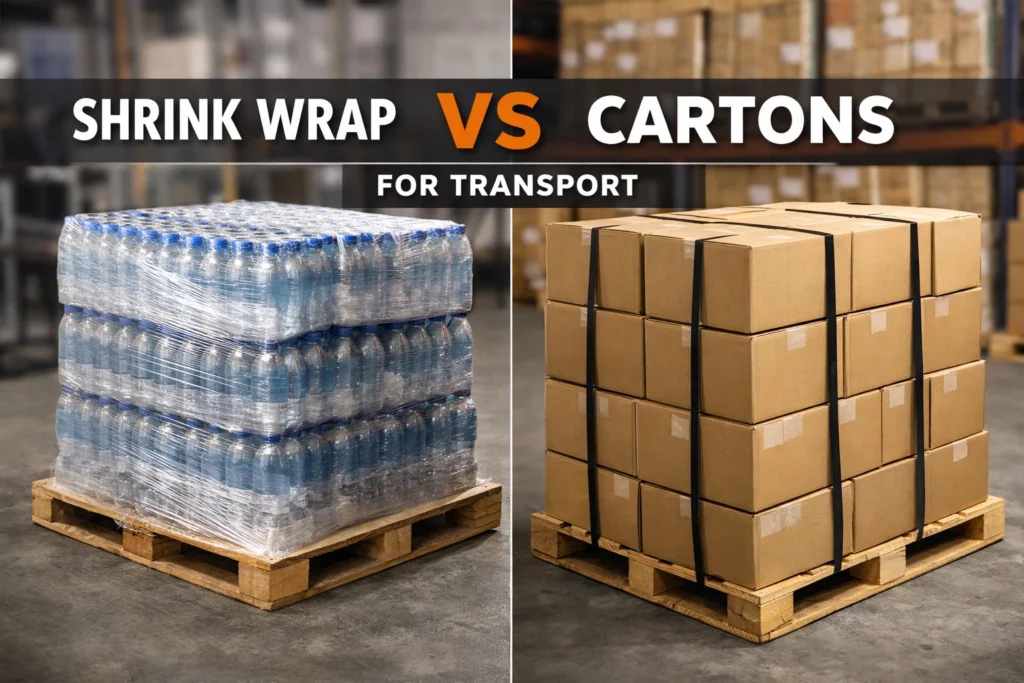
Shrink Wrap vs Cartons for Transport: Which Packaging Method Is Best?

shrink wrap vs cartons for transports

Choosing between shrink wrap and cartons for transport is about more than simply packaging a product. The right choice affects shipping costs, warehouse space, product protection, sustainability, labour requirements and customer satisfaction.

While shrink wrapping is ideal for securing pallet loads, bundling products and reducing packaging costs, cartons provide superior impact protection and retail-ready presentation for individual products. Many manufacturers use both together to maximise protection throughout the supply chain.

In this guide, we’ll compare shrink wrap vs cartons for transport, explain the advantages and disadvantages of each method, and help you decide which solution best suits your products and production line.

What Is Shrink Wrap Packaging?

Shrink wrap is a plastic film that tightly seals around products when heat is applied. It’s commonly used for bundling items, stabilizing pallets, and protecting goods from dust, moisture, and tampering.

Key Benefits of Shrink Wrap

  • Cost-effective for large volumes
  • Provides tight, secure packaging
  • Excellent for pallet stabilization
  • Transparent for easy product identification
  • Reduces overall packaging weight

What Are Cartons in Transport Packaging?

Cartons (typically corrugated boxes) are rigid containers used to store and transport goods. They provide structural protection and are widely used across industries.

Key Benefits of Cartons

  • Strong protection against impact
  • Stackable for efficient storage
  • Ideal for individual product packaging
  • Easy to label and brand
  • Recyclable and eco-friendly options available

Comparison: Shrink Wrap vs Cartons

FeatureShrink WrapCartons
Packaging CostLowerHigher
Material WeightVery lightHeavier
Product ProtectionGood against dust & moistureExcellent against impact
Storage SpaceMinimalRequires warehouse space
BrandingLimitedExcellent printing options
Shipping CostLower due to reduced weightHigher
AutomationEasy to automateRequires carton erectors/packers
Best ForPallets, multipacks, bundlesIndividual products, fragile items

Shrink Wrap vs Cartons for Transport: Key Differences

1. Protection Level

  • Shrink Wrap: Best for light protection, dust, and moisture resistance
  • Cartons: Superior protection against crushing, impact, and rough handling

If your products are fragile, cartons are usually the safer option.

How Products Are Protected During Transport

Shrink wrap keeps products tightly bundled together, preventing movement during transport while protecting against dust, moisture and tampering. However, because the film is flexible, it provides limited cushioning against heavy impacts.

Corrugated cartons absorb shocks and distribute external forces more effectively, making them the preferred option for fragile products such as glass, electronics and pharmaceutical products.

For long-distance freight or export shipments, many companies package products inside cartons before securing the cartons to pallets using shrink wrap. This combination provides the highest level of transport protection.

2. Cost Efficiency

  • Shrink Wrap: Lower material cost and reduced labor with automation
  • Cartons: Higher material and storage costs

Shrink wrap is often more economical for bulk shipments and pallet loads.

3. Space and Storage

  • Shrink Wrap: Minimal storage space required for materials
  • Cartons: Require significant storage space before use

Shrink wrap wins for warehouses with limited space.

Shrink Wrap vs Cartons: Warehouse Efficiency

Warehousing costs continue to rise, making storage efficiency increasingly important.

Shrink wrap requires very little storage space because the film is supplied on compact rolls. Thousands of metres of film can be stored in the footprint needed for a small pallet.

Cartons, on the other hand, require dedicated storage areas. Even when supplied flat-packed, they occupy significantly more warehouse space and require assembly before use.

For manufacturers operating high-volume production lines, shrink wrap often provides lower warehouse costs and faster packaging operations.

4. Sustainability

  • Shrink Wrap: Typically plastic-based (though recyclable options exist)
  • Cartons: Widely recyclable and biodegradable

Cartons are generally more environmentally friendly.

Shipping Costs: Which Packaging Saves More?

Packaging weight directly affects transport costs, particularly for businesses shipping products across South Africa or exporting internationally.

Because shrink film is lightweight, it reduces the overall shipping weight compared to corrugated cartons. Lower package weight can reduce freight costs while allowing more products to fit within the same shipment.

Cartons increase package weight but provide additional protection that may reduce damage-related returns and replacement costs.

Businesses should evaluate both freight costs and product damage risks when choosing between shrink wrap and cartons.

5. Branding and Presentation

  • Shrink Wrap: Limited branding opportunities
  • Cartons: Excellent for printing logos, product info, and marketing

Cartons are ideal for retail-facing products.

When to Use Shrink Wrap

Shrink wrap is best suited for:

  • Palletizing goods for transport
  • Bundling multiple items together
  • High-volume distribution environments
  • Products that don’t require rigid protection

Example: Bottled goods, canned products, or boxed items already in primary packaging.

When to Use Cartons

Cartons are ideal for:

  • Fragile or high-value products
  • E-commerce and direct-to-consumer shipping
  • Retail packaging and branding
  • Irregularly shaped items

Example: Electronics, glass products, or individual retail units.

Shrink Wrap vs Cartons for Transport: Which Should You Choose?

The decision between shrink wrap vs cartons for transport ultimately depends on your specific operational needs.

Choose Shrink Wrap If:

  • You want to reduce packaging costs
  • You’re shipping bulk or palletized goods
  • Speed and efficiency are priorities

Choose Cartons If:

  • Product protection is critical
  • Branding and presentation matter
  • You’re shipping individual items

Best Practice: Use Both Together

In many cases, the most effective solution is a combination of both:

  • Pack products in cartons
  • Then secure them on pallets using shrink wrap

This hybrid approach ensures maximum protection, stability, and efficiency—especially for long-distance transport.

How to Choose Between Shrink Wrap and Cartons

Choose Shrink Wrap if you:

  • Ship palletised products
  • Bundle multiple products together
  • Want lower packaging costs
  • Need fast automated packaging
  • Have limited warehouse space


Choose Cartons if you:

  • Ship fragile products
  • Require retail branding
  • Need impact protection
  • Sell products individually
  • Want recyclable paper packaging


Use Both Together if you:

  • Ship nationwide
  • Export products
  • Need maximum protection
  • Palletise boxed products
  • Want reduced transport damage

Contact Us for Packaging Solutions

There is no one-size-fits-all answer when comparing shrink wrap vs cartons for transport. The best packaging solution depends on your products, shipping distances, handling requirements and production volumes.

Shrink wrap offers excellent load stability, lower packaging costs and faster automation, making it ideal for palletised goods and high-volume manufacturing. Cartons provide superior impact protection, branding opportunities and product presentation, making them the preferred choice for fragile or retail-ready products.

For many manufacturers, the most effective solution is combining both methods—packing products into cartons and securing them to pallets with shrink wrap for safe transport.

If you’re unsure which packaging solution best suits your business, our team can recommend the right shrink wrap machine, sealing system and transport packaging solution based on your products and production requirements.

If you’re unsure whether shrink wrap vs cartons for transport is right for your operation, our team can help you find the perfect solution tailored to your needs.

Contact us today to discuss your packaging requirements and explore our range of machinery and solutions.

FAQs

1. Is shrink wrap cheaper than cartons for transport?

Yes, shrink wrap is generally more cost-effective, especially for bulk shipments and palletized goods.

2. Can shrink wrap replace cartons completely?

Not always. Shrink wrap provides limited protection, so cartons are still necessary for fragile or high-value items.

3. Which is more eco-friendly: shrink wrap or cartons?

Cartons are typically more sustainable due to their recyclability and biodegradable nature.

4. Is it better to combine shrink wrap and cartons?

Yes, combining both offers the best protection and efficiency for most transport scenarios.

5. Is shrink wrap suitable for export shipping?

Yes. Shrink wrap is widely used to stabilise pallet loads for export and long-distance transport. Many exporters combine cartons with shrink wrap to provide both impact protection and load stability.

6. Which industries use shrink wrap instead of cartons?

Industries such as beverage manufacturing, FMCG, food processing, pharmaceuticals, building materials and industrial manufacturing commonly use shrink wrap for bundling products and securing pallet loads.