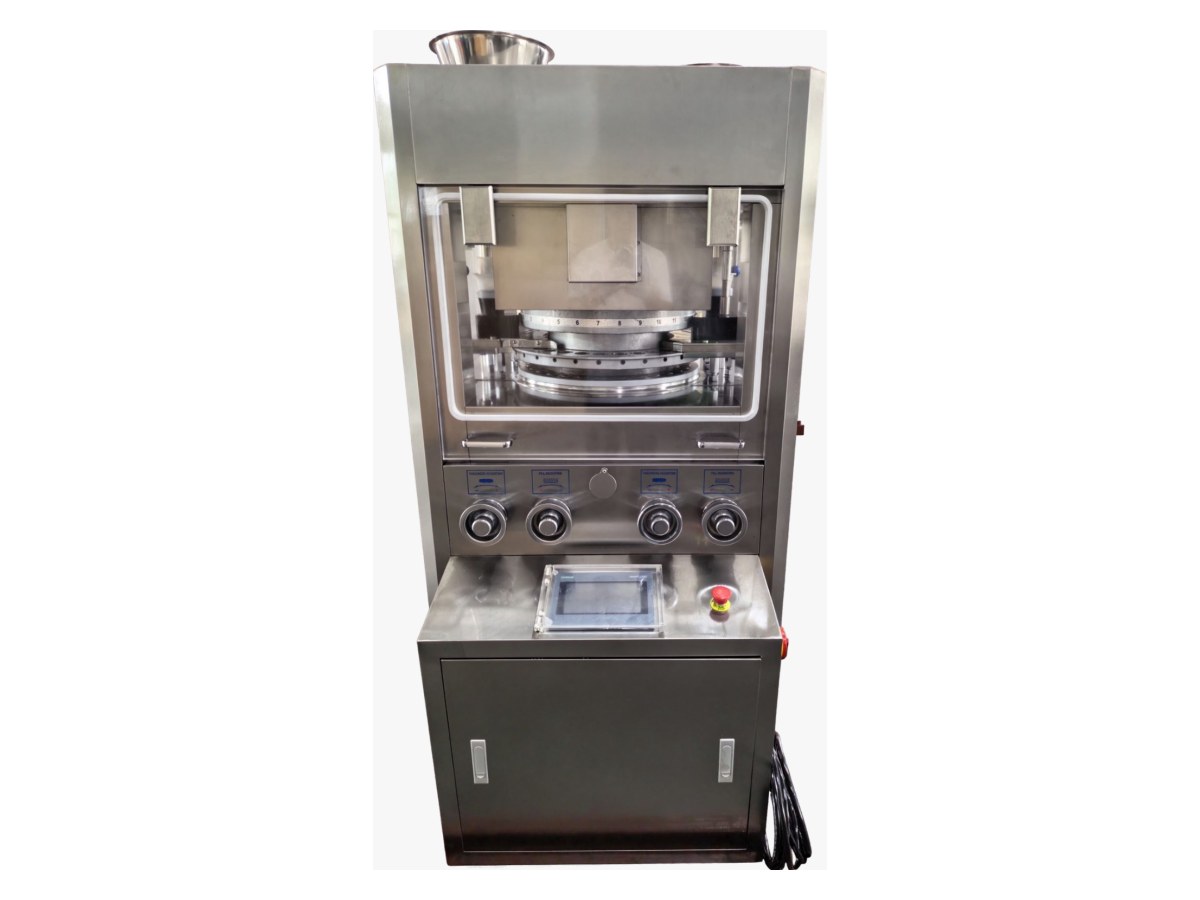
Machine OverviewDouble-sided rotary tablet pressing
| Machine type | Double-sided rotary tablet press |
| Products | Granules pressed into round, shaped or engraved tablets |
| Stations | 29 (D tooling) or 43 (B tooling) |
| Maximum pressure | 100 kN |
| Output | Up to 139,200 or 206,400 tablets an hour |
| Feeding | Closed forced feeder |
| Controls | PLC with colour touch screen |
Applications
A tablet press machine, also called a rotary tablet press, compresses granules into tablets of a set weight, thickness and hardness. It is used mainly in the pharmaceutical industry, and also for food, chemical and electronic products made in tablet form. The press makes round tablets, special shapes and tablets engraved on both sides.
The tablet press is the first machine in a tablet line. Pressed tablets then go to tablet coating, and on to packing on a counting machine, strip packing machine or blister and cartoning line.
See the full range on our pharmaceutical packaging machines page.
Specifications
A tablet press machine is chosen by tablet size and output. The ZPG-29 uses D tooling for tablets up to 25 mm across, at up to 139,200 tablets an hour. The ZPG-43 uses B tooling for tablets up to 13 mm round, with more stations for up to 206,400 tablets an hour.
| Specification | ZPG-29 | ZPG-43 |
|---|---|---|
| Stations (die sets) | 29 | 43 |
| Tooling | D tooling | B tooling |
| Maximum pressure | 100 kN | 100 kN |
| Maximum fill depth | 18 mm | 18 mm |
| Maximum tablet thickness | 6 mm | 6 mm |
| Maximum round tablet diameter | 25 mm | 13 mm |
| Maximum shaped tablet size | 25 mm | 16 mm |
| Maximum output | 139,200 tablets an hour | 206,400 tablets an hour |
| Maximum turret speed | 40 rpm | 40 rpm |
| Main motor | 7.5 kW | 7.5 kW |
| Machine height | 1,800 mm | 1,800 mm |
| Footprint | 1,200 × 900 mm | 1,200 × 900 mm |
| Weight | 2,380 kg | 2,380 kg |
Not sure which tooling fits your tablet? Send us your tablet size, shape and target output and we will recommend a rotary tablet press.
About our model codesModel codes shown are the base models in the range. Your machine is specified and configured to suit your product, output and pack format, not supplied off the shelf.
About the machine
Granules flow from the hopper into a closed forced feeder, which fills each die in the rotating turret evenly, even at high speed. As the turret turns, upper and lower punches compress the granules in each die. The press works on both sides of the turret, so two tablets are made at every station on each turn, and the finished tablets are ejected onto the discharge chute.
A pressure display shows the compression force, and the press stops automatically if the pressure goes over the limit. The work area is fully enclosed behind transparent windows to keep out dust, and parts in contact with the product are stainless steel or surface-treated to prevent cross-contamination, in line with GMP requirements.
Comparison
Both rotary tablet presses share the same frame, pressure and turret speed. The difference is the tooling, which sets the tablet size and the number of stations.
| ZPG-29 | ZPG-43 | |
|---|---|---|
| Tooling | D tooling | B tooling |
| Largest round tablet | 25 mm | 13 mm |
| Stations | 29 | 43 |
| Maximum output | 139,200 tablets an hour | 206,400 tablets an hour |
| Suits | Larger tablets and shapes | Smaller tablets at higher output |
After pressing, tablets usually go to a tablet coating machine.
“Highly recommended! Excellent customer service, great prices, and they always go above and beyond.”
Ratings and reviews are published on our Google Business Profile, where they can be read in full and in context.
PackMan purchased an Automatic 6-Lane, 4-Side Seal Vinegar Packaging Machine, and it has been performing reliably since installation. The machine delivers consistent packaging quality, operates efficiently, and has met our production expectations.

SA Packaging Machinery delivered a solution that has met our expectations. The equipment has been reliable in daily production, and we’re pleased with its performance. We found the team knowledgeable, professional, and willing to assist whenever required.

We’ve been very happy with the equipment supplied by SA Packaging Machinery. It’s straightforward to use, performs consistently, and has helped us improve our production process. The team was easy to work with and made the entire experience smooth.

Advantages
A rotary tablet press makes tablets continuously rather than one at a time: the turret keeps turning, the forced feeder fills every die evenly, and the double-sided design presses two tablets per station on each turn. That gives consistent tablet weight at high output, with overload protection, an emergency stop and fault alarms built in, and a fully enclosed work area that is easy to keep clean.
Quotation
A rotary tablet press is quoted to your formulation, tablet and output, so the quotation starts from your product rather than a list price. Send us your tablet details and target output and we will confirm the right model and quote it.
Why us
Every rotary tablet press we supply is installed and commissioned on your floor, with operator training, spare parts held in Johannesburg and technical support once you are running.
Installation and commissioning.
We position the tablet press, connect power, fit the tooling for your tablet, and run a first batch with your own granules before handover.
Operator training.
Your operators are trained on punch and die changes, setting fill depth and pressure, reading the pressure display and alarms, and cleaning between products.
Service, spares and support.
Spare parts are held in Johannesburg, with service across South Africa and into neighbouring SADC markets.
Choosing the right rotary tablet press comes down to these points:
You might also like
Browse the full range
Filling MachinesSealing MachinesFlow WrapHorizontal Fill-SealHorizontal Form-Fill-SealCartoningCup Fill and SealTube Fill and SealLabellingShrink Sleeve LabellingShrink TunnelSleeve Sealer and Shrink TunnelL-Bar SealerSide Bar SealerBlister and ClamshellBottle Filling MachineBottle CappingCan Fill-SeamWrapping MachinesPiston FillerAuger FillerScrew ConveyorZ-Type Bucket ElevatorVacuum PackagingPallet Wrapping
SA Packaging Machinery supplies rotary tablet presses across South Africa and Southern Africa. Send us your tablet details and target output and we will confirm the right model, recommend the tooling, and quote it. We have supplied packaging machines since 2017.
Questions
A tablet press machine, also called a rotary tablet press, compresses granules into tablets in dies on a rotating turret, using upper and lower punches to set the tablet weight, thickness and hardness.
The ZPG-29 rotary tablet press makes up to 139,200 tablets an hour and the ZPG-43 up to 206,400, depending on the product.
The ZPG-29 rotary tablet press makes round tablets up to 25 mm across, and the ZPG-43 up to 13 mm. Both make tablets up to 6 mm thick.
Yes. The rotary tablet press makes special shaped tablets and tablets engraved on both sides, with the tooling made to your design.
The rotary tablet press has overpressure protection that stops the machine automatically, an emergency stop, a frequency converter fault alarm, and a fully enclosed work area.
After the rotary tablet press, tablets usually go to a tablet coating machine, then to packing on a counting machine or blister and cartoning line.