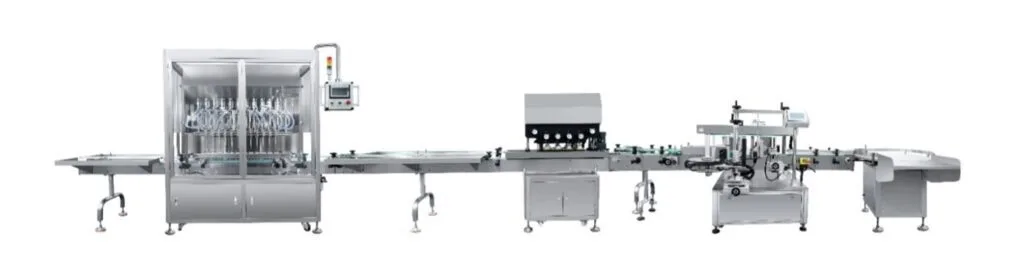
Machine Overview
| Machine type | Tube filler and sealer |
| Products | Creams, gels, ointments, pastes and liquids |
| Tube materials | Plastic, laminated and aluminium |
| Output | 30–200 pcs/min depending on model |
| Tube diameter | φ13–60 mm depending on model |
| Filling accuracy | ≤±1% |
| Automation | Semi-automatic or fully automatic |
| Utilities | 380/220 V, compressed air 0.55–0.65 MPa |
Configurations
A tube filler and sealer loads a pre-formed tube, fills it to volume, and seals the open end with heat or by crimping, depending on the tube material. Four configurations cover automation level and tube material, and three sizes cover output from 30 to 200 pieces per minute. If you are still deciding between tube materials, see the comparison below.

Heat-sealed closure on plastic and laminated tubes, fully automatic feed through discharge. The standard choice for continuous cosmetic and pharmaceutical cream production.
Mechanical fold-and-crimp closure on metal and ALU tubes, fully automatic. Built for products needing the barrier protection only an aluminium tube gives.
An operator loads tubes by hand; the machine fills and heat-seals. The lower-cost entry point for start-ups, contract packers and product development runs.
Manual tube loading paired with automatic fill and crimp-seal. Gives the barrier protection of aluminium tubes without the investment of a fully automatic line.
Applications
Tube material and sealing method are matched to the product and the industry it serves. These are the four sectors we supply into most.

Facial creams, moisturisers, lotions, lip gloss and balm, beauty serums, sunscreen and hair care products, mostly run on plastic or laminated tubes.

Ointments, medicated creams, gels and topical treatments, where hygienic construction and the barrier protection of aluminium tubes both matter.

Silicone products, industrial adhesives, sealants, greases, lubricants and chemical pastes, where fill accuracy matters as much as a leak-resistant seal.

Toothpaste, food pastes, sauces and syrups, where the tube gives a portion-controlled, mess-free dispensing format.
Applications
Cosmetics and personal care. Retail presentation:
Pharmaceutical. Hygienic, accurate dosing:
Chemical and industrial. High-viscosity products:
The guides below cover the buying questions we are asked about most for tube filling lines.
Choosing: tube filling machines for creams, gels and ointments · tube filling for cosmetics, pharma and industrial
Specifications
A tube filler and sealer is specified by tube material and size range first, output second. Six models split across three sizes (400/800/1200) and two tube-material families (F for plastic/laminated, L for metal/ALU).
Sizing the machine. Choose the F or L variant by tube material, then the size (400/800/1200) by target output. Tube diameter range narrows on the L (metal/ALU) variants since crimping is more size-sensitive than heat sealing.
Plastic and laminated tubes are heat-sealed; metal and ALU tubes are sealed by mechanically folding and crimping the open end. Filling accuracy is ≤±1% across every model.
Output ranges from 30 pcs/min on the smallest model up to 200 pcs/min on the largest. Real speeds are confirmed on a trial with your product and tube.
| Model | SAP-400F | SAP-400L | SAP-800F | SAP-800L | SAP-1200F | SAP-1200L |
|---|---|---|---|---|---|---|
| Tube material | Plastic, laminated | Metal, ALU | Plastic, laminated | Metal, ALU | Plastic, laminated | Metal, ALU |
| Tube diameter (mm) | φ13–60 | φ13–35 | φ13–50 | φ13–32 | φ13–50 | φ13–32 |
| Tube length (mm) | 50–220 | 50–220 | 50–220 | 50–220 | 50–220 | 50–220 |
| Filling volume (ml) | 3–400 | 3–150 | 3–150 | 3–150 | 3–150 | 3–150 |
| Filling accuracy | ≤±1% | ≤±1% | ≤±1% | ≤±1% | ≤±1% | ≤±1% |
| Output (pcs/min) | 30–70 | 30–70 | 60–140 | 60–140 | 150–200 | 150–200 |
| Power | 6 kW | 3 kW | 11 kW | 5 kW | 28 kW | 19 kW |
| Dimensions L×W×H (mm) | 2650×1050×2000 | 2650×1050×2000 | 3300×1500×2000 | 3300×1500×2000 | 4400×1800×2100 | 4400×1800×2100 |
| Weight (kg) | 900 | 900 | 2200 | 2200 | 2500 | 2500 |
Air pressure is 0.55–0.65 MPa and air consumption 0.1 m³/min across every model. CE certificates are available on request.
| Parameter | Specification |
|---|---|
| Tube materials | Plastic, laminated, metal and ALU tubes |
| Sealing method | Heat sealing (plastic/laminated) or mechanical fold-and-crimp (metal/ALU) |
| Features | No-tube-no-fill detection, dust aspiration, quality-control sensors, PLC touchscreen |
| Construction | Hygienic stainless steel |
| Automation | Semi-automatic or fully automatic |
| Utilities | 380/220 V; compressed air 0.55–0.65 MPa, 0.1 m³/min |
| Options | Stirring devices, saddle folding, batch and date coding, cartoning integration |
Not sure whether plastic or aluminium tubes suit your product? Read the comparison below, then send us your product and tube for a trial.
About our modelModel codes shown are machines we have built or configured for previous projects. Your machine is specified and built to suit your product, output and pack format — not supplied off the shelf.
About the machine
A tube filler and sealer loads a pre-formed tube, fills it to volume through the open end, then seals that end shut — by heat on plastic and laminated tubes, or by mechanically folding and crimping on metal and ALU tubes. The cap end of the tube arrives pre-sealed from the tube manufacturer.
Fill volume, seal temperature or crimp pressure are set per product and tube, and held in the machine controls, so a changeover is a settings change rather than a rebuild.
Downstream the filled tube feeds cartoning or case packing, or goes straight to retail packing.
For the choice between plastic and aluminium tubes, see the comparison below.

Tube filling suits any product that benefits from portion-controlled, squeeze-tube dispensing across a wide viscosity range.
Typical products are cosmetic creams and lotions, pharmaceutical ointments and gels, food pastes, and industrial adhesives and sealants.
For the finished tube, our cartoning machine page covers case-ready packaging.
Comparison
Both fill and seal tubes accurately; the difference is production capacity and how much of the cycle the operator handles.
| Automatic | Semi-automatic | |
|---|---|---|
| | |
| Operation | Feed, fill, seal, code and discharge automatic | Operator loads and removes tubes by hand |
| Speed | Higher, continuous | Lower, operator-paced |
| Investment | Higher | Lower entry cost |
| Changeovers | Line settings change | Quick, simple changeover |
| Best for | Medium to large manufacturers, continuous lines | Start-ups, contract packers, pilot runs |
Choose automatic for continuous, high-volume production; choose semi-automatic for lower volumes, frequent product changes, or a lower entry cost.
Tube material affects appearance, product protection and sealing method. Both run through the same filling station; the sealing head differs.
| Plastic tubes | Aluminium tubes | |
|---|---|---|
| | |
| Appearance | Attractive retail finish, printable | Metallic, premium pharmaceutical look |
| Protection | Good, standard barrier | Superior barrier against light, air, moisture |
| Sealing method | Heat sealing | |
| Best for | Cosmetic creams, lotions, toothpaste, food pastes | Pharmaceutical ointments, adhesives, sensitive formulations |
| Shelf life | Standard | Extended, better stability |
Guides
No case studies exist for this machine yet — here are the guides we send to anyone choosing between shrink sleeve, self-adhesive labelling, and tunnel type.
“Highly recommended! Excellent customer service, great prices, and they always go above and beyond.”
Ratings and reviews are published on our Google Business Profile, where they can be read in full and in context.
PackMan purchased an Automatic 6-Lane, 4-Side Seal Vinegar Packaging Machine, and it has been performing reliably since installation. The machine delivers consistent packaging quality, operates efficiently, and has met our production expectations.

SA Packaging Machinery delivered a solution that has met our expectations. The equipment has been reliable in daily production, and we’re pleased with its performance. We found the team knowledgeable, professional, and willing to assist whenever required.
We’ve been very happy with the equipment supplied by SA Packaging Machinery. It’s straightforward to use, performs consistently, and has helped us improve our production process. The team was easy to work with and made the entire experience smooth.
Advantages
A tube gives a product portion control and a familiar squeeze-dispense format that a jar or bottle cannot, which is why cosmetic, pharmaceutical and food brands default to it for creams, gels and pastes. Because tube material and automation level are chosen independently, the same underlying machine design scales from a start-up’s first semi-automatic unit to a fully automatic line running 200 tubes a minute.
Machines used for pharmaceutical or food products are supplied in hygienic stainless steel and can be specified with quality-control sensors for jammed or reversed tubes and air pressure drops.
Quotation
A tube filler and sealer is quoted to your product and tube, so the quotation is built from a trial run rather than a list price. Send us your product and tube and we will trial it and quote the configuration that suits it.
Why us
Every tube filler and sealer we supply is installed and commissioned on your floor, with operator training, a spare-parts holding in Johannesburg and technical support once you are running.
Installation and commissioning.
We position the machine, connect the electrical and compressed air supply, set fill volume and seal temperature or crimp pressure against your own product and tube, and hand over once fills and seals are consistent.
Operator training.
Your operators are trained on tube loading, fill-volume calibration, seal or crimp settings, PLC operation, and the wear items worth keeping on the shelf.
Service, spares and support.
Filling nozzles, seal heads, crimping dies and sensors are held in Johannesburg, with service across South Africa and into neighbouring SADC markets.
Choosing the right tube filling configuration comes down to five things:
You might also like
SA Packaging Machinery supplies tube filler and sealer lines across South Africa and Southern Africa. Send us your product and tube and we will trial it, recommend the configuration, and quote it.
Questions
A packaging system that loads a pre-formed tube, fills it to volume, and seals the open end using heat (plastic and laminated tubes) or mechanical crimping (metal and ALU tubes).
Cosmetic creams and lotions, pharmaceutical ointments and gels, food pastes such as toothpaste and sauces, and industrial products like silicone sealants and adhesives.
Both. Plastic and laminated tubes run on the F models with heat sealing; metal and ALU tubes run on the L models with mechanical fold-and-crimp sealing. Tube diameter ranges from φ13 mm to 60 mm depending on the model.
Plastic and laminated tubes suit retail presentation and printing; aluminium tubes give superior barrier protection for light, air and moisture-sensitive products. Our full comparison covers the decision.
Output ranges from 30 pieces per minute on the smallest model up to 200 on the largest, with filling accuracy of ≤±1% across the range. Real output is confirmed on a trial with your product.
Choose automatic for continuous, high-volume production; choose semi-automatic for lower volumes, frequent product changeovers, or a lower entry cost.
Yes. Additional stirring devices, saddle folding equipment, batch and date coding, and cartoning line integration can all be added to suit specific applications.
Routine care: clean filling nozzles and seal heads, inspect crimping dies for wear, check dust aspiration and quality-control sensors, and calibrate fill volumes.