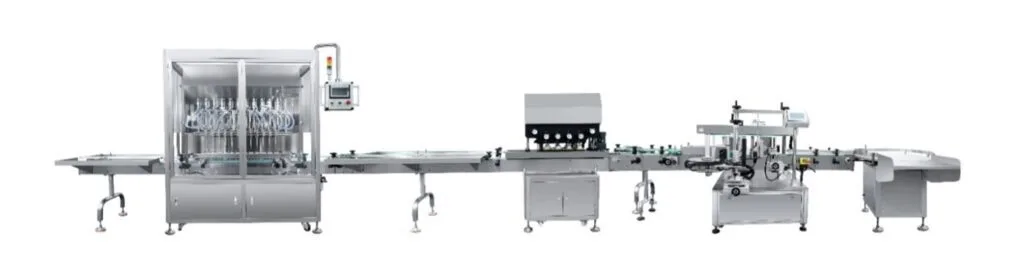
Machine Overview
| Machine type | Piston filler, capper and labeller line |
| Products | Liquids, creams and pastes: food, beverage, cosmetic, chemical and pharmaceutical |
| Output | 20–130 bottles/min depending on model and product |
| Filling range | 2 ml to 5 L, customisable |
| Filling heads | 1 (single) up to 12, depending on model |
| Accuracy | ±0.5–1% depending on model |
| Bottle types | PET, HDPE, glass and plastic; round, square and custom shapes |
| Utilities | 220–415 V depending on configuration, compressed air 0.6–0.8 MPa |
Configurations
A bottle filler-capper-labeller fills each bottle by volume, closes it, and applies a label, either as three separate stations or as one integrated line. The filling technology and head count are matched to your product’s viscosity and your target output. If you are still deciding between machine types, start at our full machine range.

01
Eight filling heads on a single machine, built for medium to high-volume lines running liquids, creams and pastes. Strong filling consistency across a wide viscosity range, with less product waste than a single-head line.
02
A servo-driven piston system where the filling heads move synchronously with bottles on the conveyor, so filling never stops for the next bottle to arrive. Built for viscous and semi-fluid products: honey, sauces, creams and detergents.

03
The largest of the three configurations, combining the tracking piston system with 12 heads for continuous industrial-scale filling. PLC touchscreen control and stainless steel construction for food-grade compliance across thick and thin products.
04
Any of the three filling configurations can run as a linear system — separate machines in sequence — or as a 3-in-1 monoblock combining rinsing, filling and capping in one compact, closed unit for higher hygiene and a smaller footprint.
Applications
Filling technology is matched to the product, so the same line design covers thin liquids through to thick pastes. These are the three sectors we supply into most.
Water, juice, milk, sauces, honey, cooking oils and soft drinks, filled by piston or servo-driven systems accurate enough to hold a consistent fill weight across a full production run.
Shampoo, conditioner, lotion, liquid soap, creams, sanitiser and perfume, where nozzle and filling-head choice manage foaming and viscosity without wasting product.
Cleaning chemicals, industrial liquids, agricultural chemicals, detergents, disinfectants and solvents, built to handle corrosive or aggressive liquids without compromising fill accuracy.
Bottle unscramblers, custom cap and label feeders, batch coders, automatic inspection systems and integration with downstream shrink wrap or cartoning, built into the line rather than added as an afterthought.
Applications
Food and beverage. High-speed accurate filling:
Cosmetics and personal care. Foam and viscosity control:
Chemical and industrial. Corrosive and aggressive liquids:
The guides below cover the buying and running questions we are asked about most for bottle filler-capper-labeller lines.
Choosing: complete guide to bottling machines · choosing a bottling machine · how to choose the right setup
Cost and care: bottling machine cost · bottling machine ROI · maintenance guide
By product: juice · still vs carbonated liquids · jamming fixes
For every machine in the range that fills liquid, and how the filler is matched to thin, foamy, hot or viscous products, see liquid filling machines.
Specifications
A bottle filler-capper-labeller is specified by filling technology and head count, not a single size. Three configurations cover the range: an 8-head piston filler for general liquids, a 2–12 head tracking piston filler for viscous products, and a 12-head version for industrial-scale continuous production.
Sizing the line. Filling technology is chosen by product viscosity, head count by target output, and bottle type by change-part requirements. A trial fill on your product is the fastest way to confirm the right configuration.
All three configurations run 304/316 stainless steel construction. Filling accuracy runs ±0.5% on the tracking systems and ±1% on the 12-head automatic model.
Output ranges from 20 pcs/min on the tracking systems up to 130 bottles/min on the 8-head piston filler, depending on product viscosity and bottle size. Real speeds are confirmed on a trial with your product.
| Feature | Specification |
|---|---|
| Filling speed | 90–130 bottles/min, depending on product viscosity |
| Power | 6.6 kW |
| Filling range | 10–100 ml / 100–1000 ml / 1–5 L, customisable |
| Machine dimensions | 3000 × 1500 × 2200 mm |
| Net weight | 600 kg |
| Feature | Specification |
|---|---|
| Capacity | 20–40 pcs/min |
| Metering type | Piston |
| Construction | 304 / 316 stainless steel |
| Outline dimension | 3000 × 1350 × 1760 mm |
| Machine weight | 400 kg |
| Feature | Specification |
|---|---|
| Power supply | 2 kW, 220 V / 50 Hz |
| Air pressure | 0.6–0.8 MPa |
| Measuring accuracy | ±1% |
| Filling range | 2–100 ml, customisable |
| Capacity | 20–40 pcs/min |
| Metering type | Piston |
| Construction | 304 / 316 stainless steel |
| Machine dimensions | 3000 × 1350 × 1760 mm |
| Machine weight | 400 kg |
All three configurations can be built as a linear system or a 3-in-1 monoblock, and supplied with rinsing, capping and labelling stations to match. CE and other industry certifications are available on request.
| Parameter | Specification |
|---|---|
| Filling technologies | Gravity, piston, peristaltic pump, overflow, or servo-driven volumetric — matched to product viscosity |
| Bottle types | PET, HDPE, glass and plastic; round, square and custom shapes; change parts required per size |
| Caps | Screw, snap-on, press-on, flip-top and sports caps; custom feeders and torque control on request |
| Labels | Self-adhesive, wrap-around, front-and-back and tamper-evident; single or multi-label stations |
| Automation | Semi-automatic to fully automatic, linear or 3-in-1 monoblock |
| Hygiene | Food-grade stainless steel construction; can be specified to HACCP and GMP standards |
| Utilities | 220–415 V three-phase depending on configuration; compressed air 0.6–0.8 MPa |
| Integration | Bottle unscramblers, conveyors, inkjet or laser coders, shrink wrap, cartoning and case packing |
Not sure which filling technology suits your product? Read the complete guide to bottling machines, then send us your product for a trial fill.
About our modelModel codes shown are machines we have built or configured for previous projects. Your machine is specified and built to suit your product, output and pack format — not supplied off the shelf.
About the machine
A bottle filler-capper-labeller fills each bottle to volume, closes it with a cap or seal, and applies a label before discharge, either as three separate machines in sequence or one integrated line. Filling technology, head count and automation level are matched to the product and the output you need.
Filling volume, torque and label placement are set per product and held in the machine controls, so a changeover between products is a settings change rather than a rebuild.
Downstream the finished bottle feeds shrink wrap, cartoning or case packing, or goes straight to palletising.
Read the full explanation in the complete guide to bottling machines.
Filling technology is chosen to match the product; the same three-station line design covers thin liquids through to thick pastes.
Typical products are water, juice, sauces, honey and cooking oils; shampoo, lotion, cream and sanitiser; and cleaning chemicals, detergents and industrial liquids.
For the finished bottle after filling, see our sleeve sealer for multipack bundling and cartoning for case-ready packaging.
Case Studies
A 3-in-1 water bottling line and a dropper-bottle CBD oil line with UV sterilisation, plus the comparisons we send to anyone weighing up linear against monoblock, or automatic against semi-automatic.
“Highly recommended! Excellent customer service, great prices, and they always go above and beyond.”
Ratings and reviews are published on our Google Business Profile, where they can be read in full and in context.
PackMan purchased an Automatic 6-Lane, 4-Side Seal Vinegar Packaging Machine, and it has been performing reliably since installation. The machine delivers consistent packaging quality, operates efficiently, and has met our production expectations.

SA Packaging Machinery delivered a solution that has met our expectations. The equipment has been reliable in daily production, and we’re pleased with its performance. We found the team knowledgeable, professional, and willing to assist whenever required.
We’ve been very happy with the equipment supplied by SA Packaging Machinery. It’s straightforward to use, performs consistently, and has helped us improve our production process. The team was easy to work with and made the entire experience smooth.
Comparison
Both run the same filling technology; the difference is layout. A linear system runs rinsing, filling and capping as separate machines; a monoblock combines all three into one compact, closed unit.
| Linear system | 3-in-1 monoblock | |
|---|---|---|
|  | |
| Layout | Separate machines in sequence | Integrated single unit |
| Floor space | Requires more space | Compact, space-saving |
| Production flow | Transfer between machines | Continuous, synchronised |
| Hygiene | Multiple transfer points | Closed system, lower contamination risk |
| Maintenance | Individual machine servicing | Centralised servicing |
| Best for | Flexible multi-product lines | High-speed beverage and water bottling |
Choose linear when you run multiple products and need flexibility; choose monoblock when you are bottling one product at speed and want the smallest footprint with the best hygiene control.
The other choice is how much of the line runs itself. Automation level sets your speed, labour cost and entry price.
| Automatic system | Semi-automatic system | |
|---|---|---|
| | |
| Operator input | Minimal — loading and supervision | Bottle placement, start/stop, transfer |
| Speed | High, continuous | Lower, paced by the operator |
| Consistency | Very high, repeatable | Good, depends on operator |
| Investment | Higher | Lower entry cost |
| Best for | Large-scale, long-term production | Smaller runs, start-ups, flexibility |
Bottle material affects cap choice, sealing method and line design. Both run through the same filler, but the capping station usually differs.
| Plastic bottles | Glass bottles | |
|---|---|---|
| | |
| Weight | Lightweight, cost-effective | Heavier, premium appearance |
| Common caps | Screw, snap-on, flip-top, sports caps | Aluminium screw, cork, dropper, tamper-evident |
| Sealing method | Induction, pressure, or threaded | Precision torque or vacuum sealing |
| Typical use | Water, juice, oils, chemicals | Beverages, pharmaceuticals, essential oils, cosmetics |
| Best when | High-speed, cost-efficient lines matter | Presentation and product protection matter |
Advantages
Running fill, cap and label as one line removes the handling and queuing time between three separate stations, which is where most contamination risk and output loss happens on a manual or part-automated setup. Because filling technology, head count and automation level are all chosen to match your product, the same line design scales from a start-up’s first automated machine to a full industrial monoblock without changing the underlying approach.
Machines used for food, beverage or pharmaceutical products are supplied in food-grade stainless steel and can be specified to HACCP and GMP standards. For the finished bottle downstream, our sleeve sealer and cartoning machine pages cover multipack and case packaging.
Quotation
A filler-capper-labeller is quoted to your product, bottle and target output, so the quotation is built from a trial fill rather than a list price. To narrow the specification before you enquire, read the complete guide to bottling machines; for what shapes the figure on any machine quotation, see the bottling machine cost guide. Send us your product and bottle and we will trial-fill it and quote the configuration that suits it.
Why us
Every filler-capper-labeller line we supply is installed and commissioned on your floor, with operator training, a spare-parts holding in Johannesburg and technical support once you are running.
Installation and commissioning.
We position the line, connect the electrical and compressed air supply, set fill volume, cap torque and label placement against your own product and bottle, and hand over once fill weights and seals are consistent.
Operator training.
Your operators are trained on filling nozzle cleaning, cap and label changeovers, calibrating fill volumes, PLC touchscreen operation, and the wear items worth keeping on the shelf.
Service, spares and support.
Filling nozzles, seals, capping heads and labelling components are held in Johannesburg, with service across South Africa and into neighbouring SADC markets. Routine care is set out in our bottling machine maintenance guide.
Choosing the right filler-capper-labeller comes down to five things:
You might also like
SA Packaging Machinery supplies bottle filler-capper-labeller lines across South Africa and Southern Africa. Send us your product and bottle and we will trial-fill it, recommend the configuration, and quote it.
Questions
An integrated packaging system that fills bottles with product, applies and seals a cap, and labels the container in one continuous line. It improves efficiency, consistency and output compared to running fill, cap and label as separate standalone machines.
Beverages, food products, pharmaceuticals and nutraceuticals, cosmetics and personal care products, and chemicals or cleaning liquids. The filling system is selected based on your product’s viscosity and the accuracy you need.
PET, HDPE, glass and plastic bottles, in round, square or custom shapes, from small-volume containers to larger bottles. Change parts are usually required when moving between different bottle sizes.
Gravity fillers, piston fillers, peristaltic pumps, overflow fillers and servo-driven volumetric fillers. Each is selected to match your product’s viscosity and the fill accuracy required.
Typical systems run between 20 and 130 bottles per minute, depending on bottle size, product type and configuration. Fully automated lines reach the higher end of that range; real output is confirmed on a trial.
From 2 ml dropper bottles up to 5 L containers across the three configurations, with filling accuracy of ±0.5% to ±1% depending on the model. Bottle size range is set by the change parts fitted to the machine.
Choose linear when you run multiple products and need flexibility, or monoblock when bottling one product at speed with the smallest footprint. Choose fully automatic for large-scale continuous production, or semi-automatic for smaller runs and a lower entry cost. Our complete guide covers the decision.
Routine care: clean filling nozzles and conveyors, inspect seals, caps and labelling components, lubricate moving parts, and periodically calibrate fill volumes. The general schedule is in our bottling machine maintenance guide.