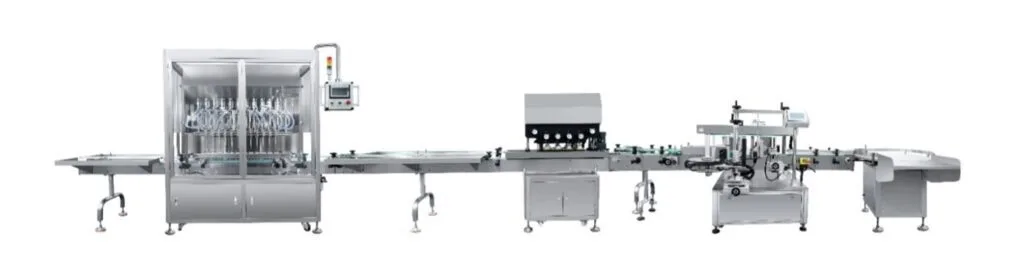
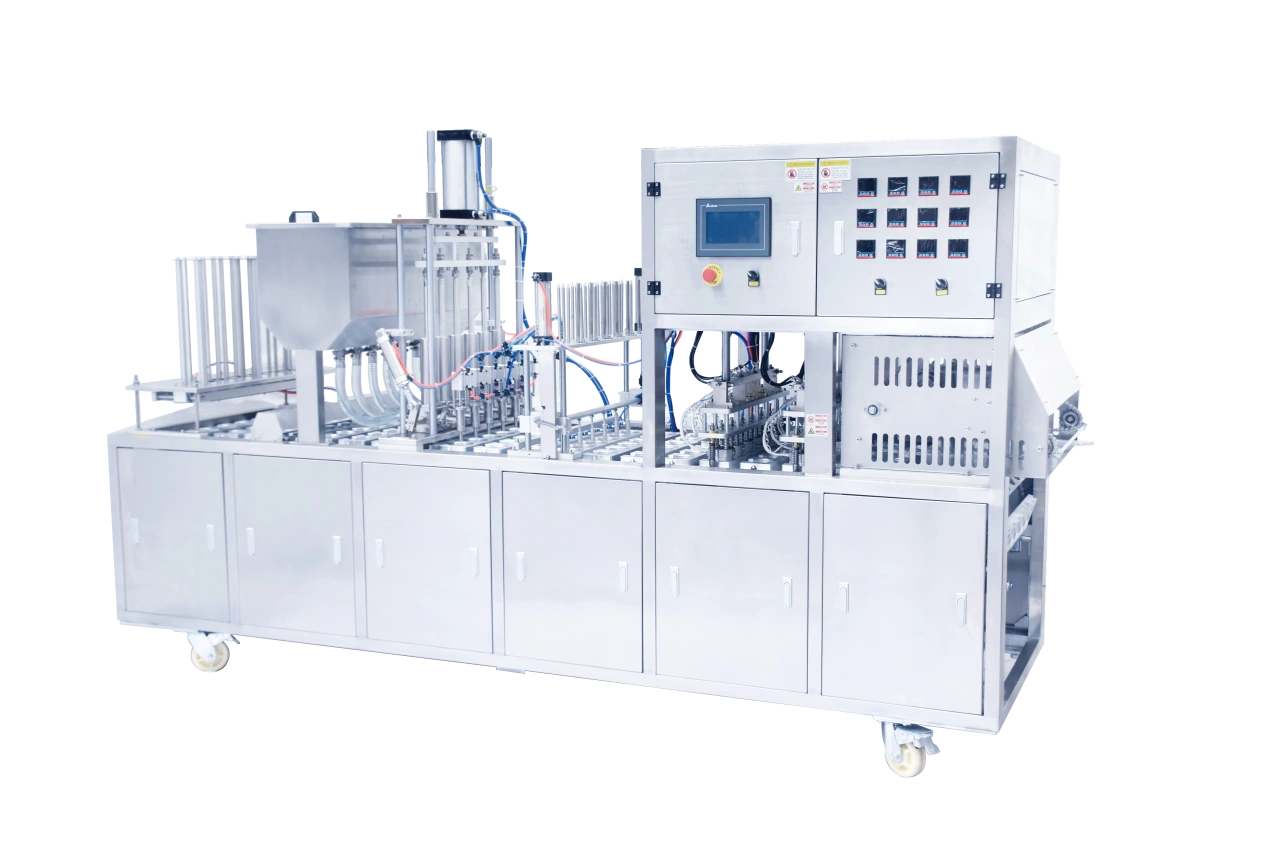
Machine Overview
| Machine type | Cup filler and heat sealer |
| Products | Powders, liquids and granules |
| Cup materials | Plastic, paper, PET and aluminium foil containers |
| Output | 2,500–36,000 cups/hour depending on model |
| Filling systems | Auger screw, measuring cup, multihead weigher or pump |
| Seal type | Aluminium foil or laminated plastic film |
| Layout | Rotary or linear |
| Utilities | 380 V three-phase, compressed air 0.8–2.5 m³/min |
Configurations
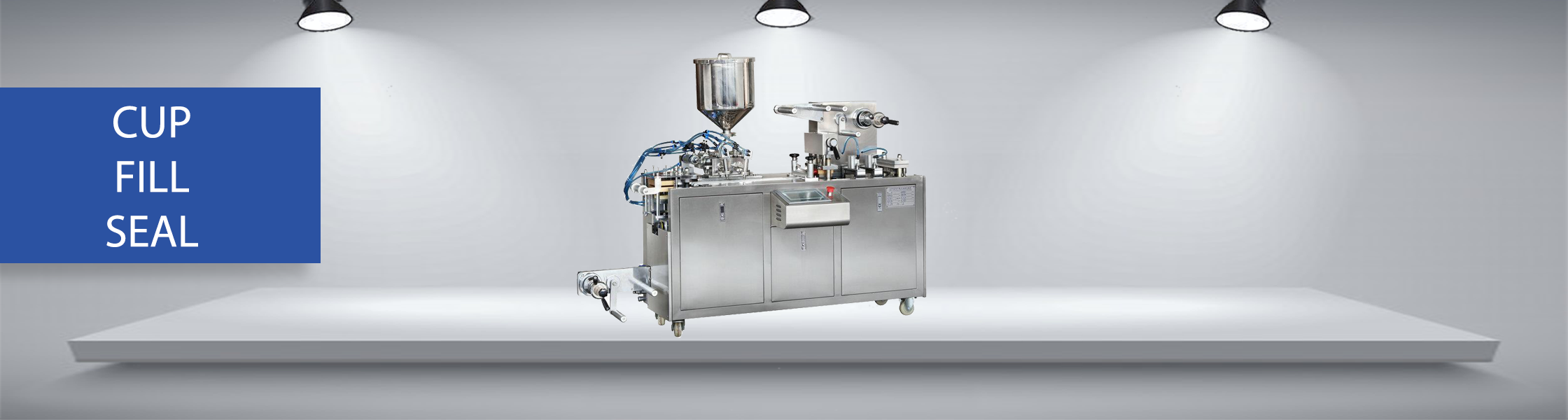
A cup filler and sealer loads a pre-formed cup, fills it by the system matched to your product, and heat-seals a foil or plastic film lid across the top. Twelve models cover output from 2,500 to 36,000 cups an hour, and three decisions shape which one you need: filling system, seal material and layout. If you are still deciding, see the comparisons below.
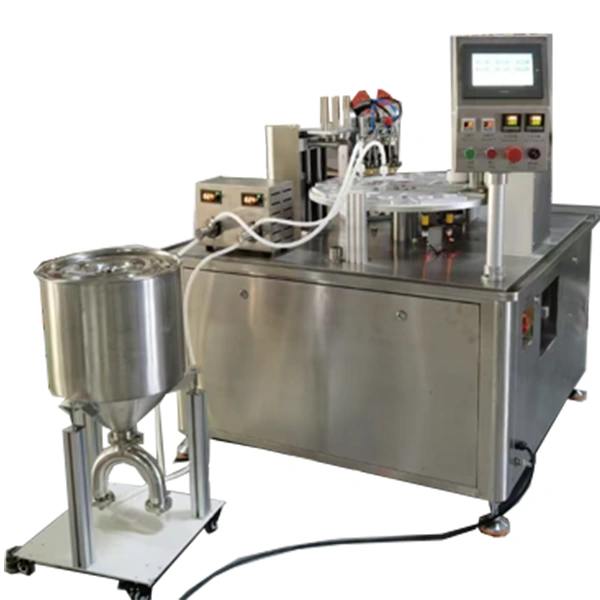
Cups move through filling, sealing, coding and discharge stations around a rotating turret. Compact footprint and smooth, continuous operation for medium to high-speed production.
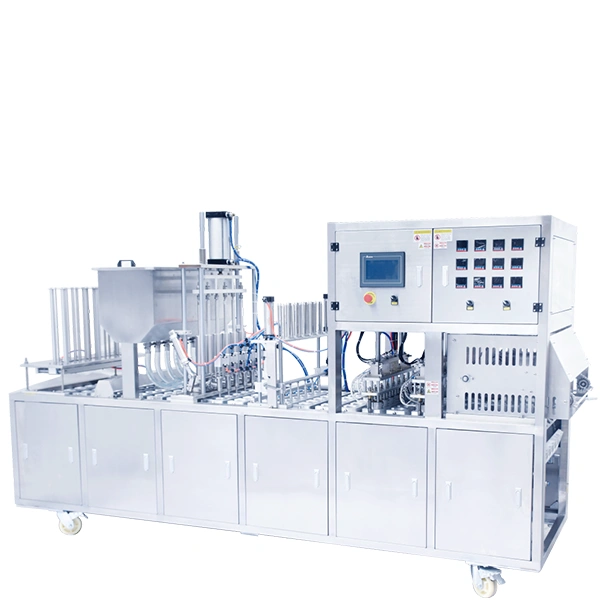
Cups move along a straight conveyor path through each processing stage. Easier to add extra stations to, and better suited to larger cup formats.
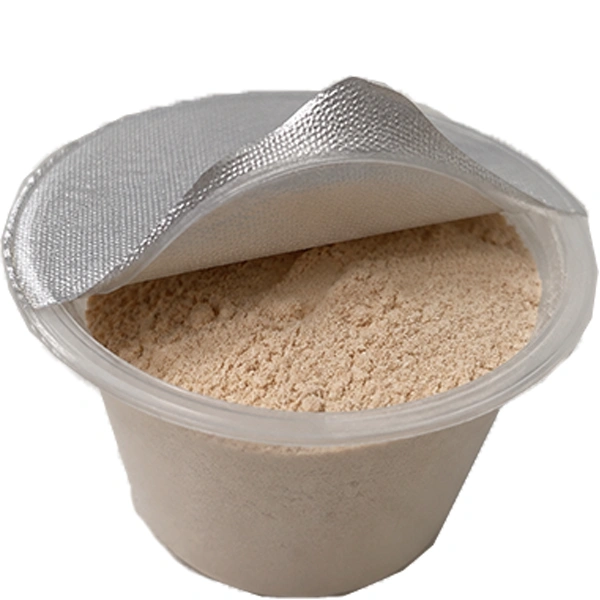
An auger screw filler or measuring cup doses free-flowing and non-free-flowing powders. Built for coffee, milk powder, protein powder and spice blends.
A pump matched to product viscosity fills liquids; a multihead weigher or measuring cup fills granules. Covers everything from water and yoghurt to nuts and sweets.
Applications
Filling system and cup material are matched to the product. These are the three product groups we supply into most.
Protein powders, nutritional supplements, instant coffee, drinking chocolate, milk powder, spice blends and seasonings, filled by auger screw or measuring cup.
Blister packs, injection medicines and bottled products, where leaflet insertion, batch coding and vision inspection are as important as the fold itself.
Yoghurt, drinking yoghurt, dairy beverages, water, juice, sauces and ready-to-drink products, filled by a pump matched to viscosity.
Sugar, salt, rice, seeds, snack products, confectionery and dry food products, filled by multihead weigher or measuring cup for gentle, accurate portioning.
Desserts, sauces, condiments and ready-to-eat portions, where a sealed cup gives portion control and shelf presentation in one format.
Applications
Powder products. Accurate, hygienic dosing:
Liquid and dairy. Hygienic volume control:
Granule and free-flowing. Gentle, accurate portioning:
The comparisons below cover the questions we’re asked most when specifying a cup filling line.
Specifications
A cup filler and sealer is specified by output and filling system first, cup format second. Twelve models cover 2,500 to 36,000 cups an hour.
Sizing the machine. Match target output to a model, then confirm filling system (powder, liquid or granule) and seal material. Step-cup and filling-head counts vary by model — higher counts generally mean higher output.
Aluminium foil gives the strongest barrier and is standard on dairy and hot-fill applications; laminated plastic film is more cost-effective and prints well for branded snack and confectionery packs.
Output ranges from 2,500 cups/hour on the smallest model up to 36,000 on the SAP-40000HB. Real speeds are confirmed on a trial with your product and cup.
| Model | SAP-2500 | SAP-3500 | SAP-5000(A) | SAP-6000IML | SAP-8000 | SAP-10000 | SAP-12000IML | SAP-12000 | SAP-20000 | SAP-20000HB | SAP-40000HB | SAP-5000(B) |
|---|---|---|---|---|---|---|---|---|---|---|---|---|
| Output (cph) | 2500 | 3500 | 5000 | 6000 | 8000 | 10000 | 12000 | 12000-20000 | 20000 | 20000 | 36000 | 5000 |
| Step cups | N/A | N/A | 4 | 8 | 6 | 8 | 12 | 12 | 16 | 12 | 24 | N/A |
| Filling heads | 2 | 3 | 4 | N/A | N/A | N/A | N/A | N/A | N/A | N/A | N/A | N/A |
| Filling volume (g/ml) | 90-400 | 90-400 | 50-300 | 100-250 | 50-300 | 50-300 | 100-250 | 30-150 | 50-300 | 30-150 | 30-150 | 50-300 |
| Air consumption (m³/min) | 0.8 | 0.8 | 0.8 | 1.5 | 0.8 | 0.9 | 1.8 | 1.8 | 1.2 | 2 | 2.5 | 0.8 |
| Weight (t) | 2.5 | 3 | 3.2 | 7.6 | 4.2 | 4.8 | 8.5 | 4.5 | 12 | 7.5 | 8.2 | 4 |
| Power (kW) | 3.5 | 3.5 | 9.5 | 115 | 10.5 | 11.5 | 130 | 65 | 45 | 85 | 101 | 4.5 |
N/A step cups indicates a rotary head-fed design; N/A filling heads indicates a step/cup-driven design. CE certificates are available on request.
| Parameter | Specification |
|---|---|
| Filling systems | Auger screw filler, measuring cup, multihead weigher, or liquid/paste pump |
| Cup materials | Plastic, paper, PET and aluminium foil containers |
| Seal materials | Aluminium foil or laminated plastic film |
| Sealing method | Heat and pressure bonding, with lid cutting |
| Layout | Rotary or linear |
| Automation | Semi-automatic or fully automatic |
| Utilities | 380 V three-phase; compressed air 0.8–2.5 m³/min |
| Options | Date coding, aluminium foil lid punching, servo-driven filling upgrades |
Not sure which filling system or seal material suits your product? See the comparisons below, then send us your product and cup for a trial.
About our modelModel codes shown are machines we have built or configured for previous projects. Your machine is specified and built to suit your product, output and pack format — not supplied off the shelf.
About the machine
A cup filler and sealer loads a pre-formed cup, fills it using the system matched to your product, then bonds a foil or plastic film lid across the top using heat and pressure before cutting the lid to size.
Fill volume, seal temperature and cup format are set per product and held in the machine controls, so a changeover is a settings adjustment.
Upstream product arrives from a mixing or dosing stage; downstream the sealed cup feeds cartoning or case packing.
For the finished cup, our cartoning machine page covers case-ready packaging.
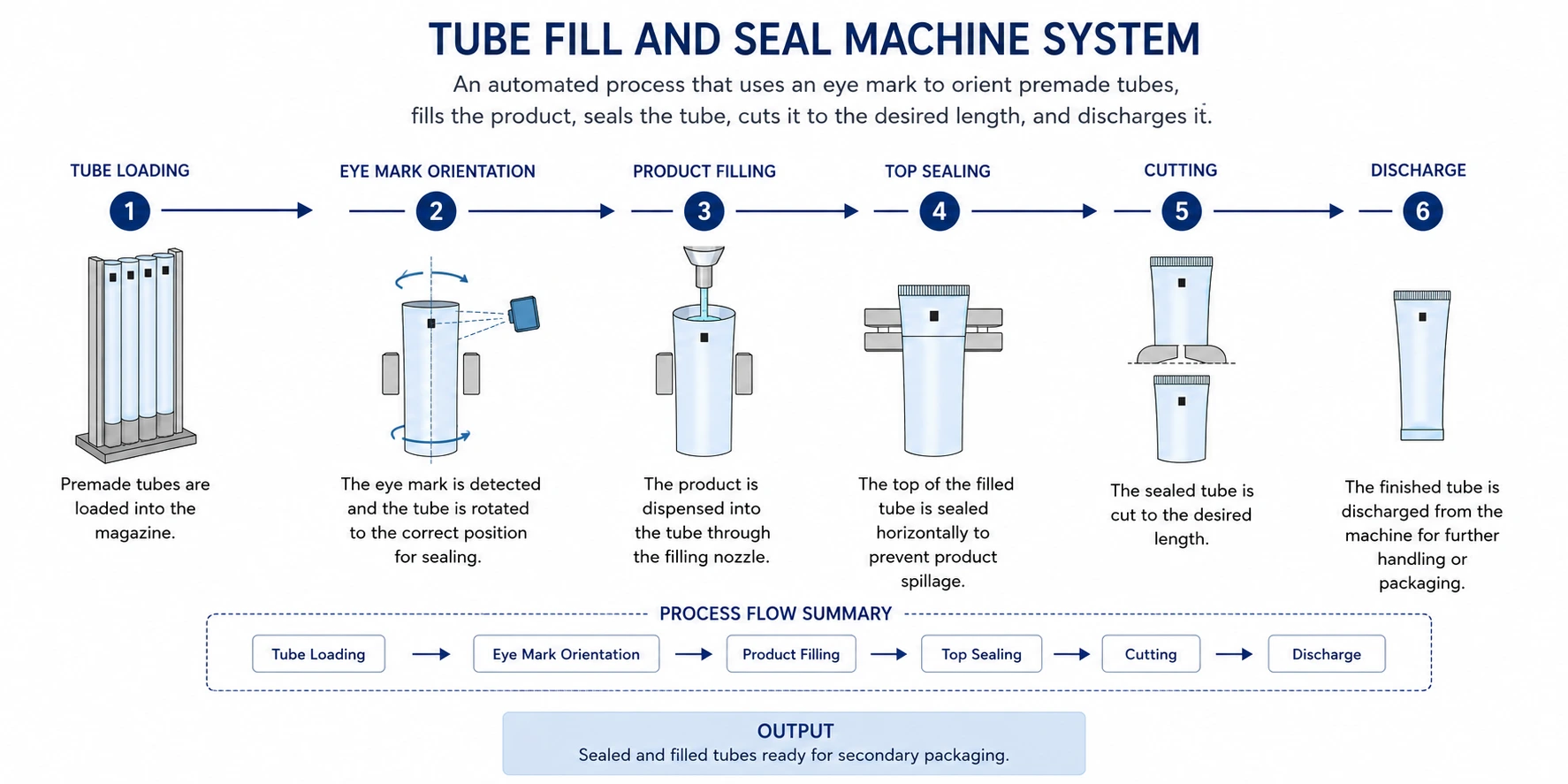
Cup filling suits any product that benefits from portion-controlled, sealed dispensing — powders, liquids and granules alike.
Typical products are yoghurt and dairy beverages, instant coffee and milk powder, sauces and condiments, and snack or confectionery portions.
For the primary pack before cartoning, see our bottle filler-capper-labeller and tube fill and seal pages.
Comparison
Both fill and seal accurately; the difference is machine layout, footprint and how easily extra stations can be added.
| Rotary | Linear | |
|---|---|---|
| | |
| Layout | Circular indexing turret | Straight conveyor path |
| Footprint | Compact | Larger, more flexible to extend |
| Speed | High, continuous | Good, easier to add inspection stations |
| Best for | Dairy, yoghurt, beverages, high volume | Large-format cups, multi-component products |
Choose rotary for compact, high-speed dairy and beverage lines; choose linear for larger cups or when you expect to add stations later.
Seal material affects barrier protection, shelf life and branding. Both run on the same sealing head; the film differs.
| Aluminium foil | Laminated plastic | |
|---|---|---|
| | |
| Barrier | Excellent, moisture/oxygen/light | Good, standard barrier |
| Shelf life | Extended | Standard |
| Printability | Limited | High-quality, attractive branding |
| Cost | Higher | Cost-effective |
| Best for | Dairy, yoghurt, hot-fill, pharma | Snacks, confectionery, promotional packs |
The filling system must match the product’s flow characteristics, not just its category.
| Powder | Liquid | Granule | |
|---|---|---|---|
| |  | |
| System | Auger screw or measuring cup | Pump matched to viscosity | Multihead weigher or measuring cup |
| Best for | Coffee, milk powder, spice blends | Water, yoghurt, sauces | Nuts, seeds, sweets, rice |
| Key benefit | Accurate low-volume dosing | Hygienic, easy-clean filling | Gentle product handling |
Match the filling system to your product’s flow characteristics rather than its category alone — a thick sauce may need a pump, not a measuring cup.
Case Studies
Cup filling and sealing machines provide a fast, hygienic solution for packaging liquid, powder and granule products into pre-formed cups across dairy, food, beverage and pharmaceutical industries.
“Highly recommended! Excellent customer service, great prices, and they always go above and beyond.”
Ratings and reviews are published on our Google Business Profile, where they can be read in full and in context.
PackMan purchased an Automatic 6-Lane, 4-Side Seal Vinegar Packaging Machine, and it has been performing reliably since installation. The machine delivers consistent packaging quality, operates efficiently, and has met our production expectations.
SA Packaging Machinery delivered a solution that has met our expectations. The equipment has been reliable in daily production, and we’re pleased with its performance. We found the team knowledgeable, professional, and willing to assist whenever required.

We’ve been very happy with the equipment supplied by SA Packaging Machinery. It’s straightforward to use, performs consistently, and has helped us improve our production process. The team was easy to work with and made the entire experience smooth.

Why us
A sealed cup gives a product hygienic, tamper-evident, portion-controlled packaging in one pass, which is why dairy and beverage brands default to it for ready-to-eat and ready-to-drink formats. Because filling system, seal material and layout are chosen independently, the same underlying machine design scales from 2,500 cups an hour to 36,000.
For the finished cup, our cartoning machine page covers case-ready packaging.
Quotation
A cup filler and sealer is quoted to your product and cup, so the quotation is built from a trial run rather than a list price. Send us your product and cup and we will trial it and quote the configuration that suits it.
Why us
Every cup filler and sealer we supply is installed and commissioned on your floor, with operator training, a spare-parts holding in Johannesburg and technical support once you are running.
Installation and commissioning.
We position the machine, connect the electrical and compressed air supply, set fill volume and seal temperature against your own product and cup, and hand over once fills and seals are consistent.
Operator training.
Your operators are trained on cup loading, fill-volume calibration, seal settings, film reel changes, and the wear items worth keeping on the shelf.
Service, spares and support.
Filling nozzles, seal heads and cutting dies are held in Johannesburg, with service across South Africa and into neighbouring SADC markets.
Choosing the right cup filling configuration comes down to five things:
You might also like
SA Packaging Machinery supplies cup filler and sealer lines across South Africa and Southern Africa. Send us your product and cup and we will trial it, recommend the configuration, and quote it.
Questions
A packaging system that loads a pre-formed cup, fills it with product, and heat-seals a foil or plastic film lid across the top before cutting the lid to size.
Powders (coffee, milk powder, protein powder), liquids (water, yoghurt, sauces), and granules (nuts, seeds, sweets, rice), across dairy, beverage, food and pharmaceutical products.
Aluminium foil gives excellent barrier protection and is standard on dairy and hot-fill products; laminated plastic film is more cost-effective and prints well for branded snack packs.
Rotary machines are compact and suit high-speed dairy and beverage lines; linear machines suit larger cups or when extra stations may be added later.
Output ranges from 2,500 cups per hour on the smallest model up to 36,000 on the largest. Real output is confirmed on a trial with your product and cup.
By flow type: auger screw or measuring cup for powders, a pump matched to viscosity for liquids, and a multihead weigher or measuring cup for granules.
Yes. Date coding, aluminium foil lid punching, servo-driven filling upgrades, dust extraction and line integration can all be added to suit your application.
Routine care: clean filling nozzles and seal heads, inspect cutting dies for wear, check film reel tracking, and calibrate fill volumes.