Choosing the right flow wrap machine is one of the most important decisions for any packaging operation. The right machine can improve productivity, reduce packaging waste, maintain consistent seal quality and support future business growth. Selecting the wrong machine, however, can lead to unnecessary downtime, higher operating costs, increased film waste and expensive upgrades.
Every manufacturing business has unique packaging requirements. Factors such as product size, shape, production speed, packaging material and automation requirements all influence which machine is best suited to your operation. A flow wrap machine that performs well in a bakery may not be the ideal solution for packaging medical devices, hardware or confectionery products.
Whether you are investing in your first packaging machine or upgrading an existing production line, taking the time to evaluate your requirements can help you maximise your return on investment and avoid costly mistakes.
This buying guide explains the most important factors to consider when choosing a flow wrap machine, helping you compare available options and make an informed purchasing decision.
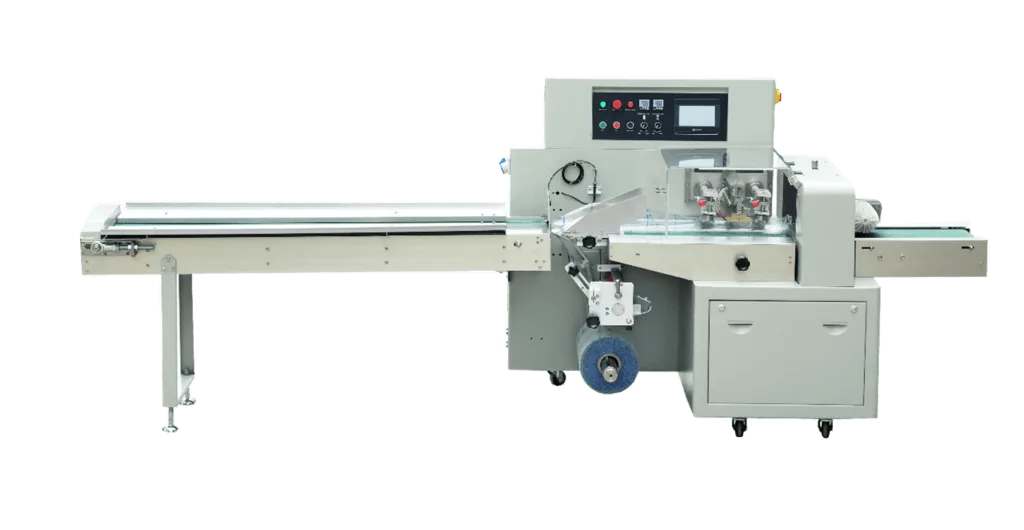
A flow wrap machine, also known as a horizontal flow wrapping machine, is an automated packaging system that wraps individual products in a continuous roll of flexible packaging film. The machine forms the film around the product, seals it along the length and ends of the package, and cuts each finished pack to size in one continuous process.
Flow wrapping is widely used because it offers fast production speeds, consistent packaging quality and excellent product protection. It is suitable for packaging a wide range of products across industries, including:
Many modern flow wrap machines can operate with printed or plain packaging films, making them suitable for both retail-ready packaging and industrial applications. If you’re new to this packaging technology, read our guide on What Is a Flow Wrap Packaging Machine? before continuing.
The first step in choosing a flow wrap machine is understanding the characteristics of the product you intend to package. Every machine is designed to operate within specific size, weight and product handling limits. Matching the machine to your product ensures reliable operation, high-quality seals and efficient production.
Before speaking to a packaging supplier, record the following information for every product you intend to package.
Accurate product measurements are essential when selecting the correct flow wrap machine.
Measure the following:
These dimensions determine:
Products that vary significantly in size may require adjustable guides or quick-change tooling to minimise changeover times.
Tip: Always measure the largest product that the machine will need to package, rather than the average size.
Product weight also plays an important role in machine selection.
Lightweight products generally move easily through the machine, while heavier products require stronger conveyors and stable product handling systems to maintain consistent spacing throughout the packaging process.
For heavier products, your supplier may recommend:
Selecting equipment designed for the correct product weight helps improve machine reliability and reduces unnecessary wear on moving components.
Not every product moves through a flow wrapper in the same way.
Some products are:
Each shape presents different handling requirements.
For example, delicate bakery products may require gentle infeed systems to prevent damage, while cylindrical products often need product guides to stop them from rolling during packaging. Fragile medical devices or precision components may require customised handling systems to ensure accurate positioning before sealing.
The more information you can provide about your product, the easier it becomes to recommend a machine that delivers reliable packaging performance.
Many manufacturers package more than one product using the same machine.
If your business regularly packages products with different dimensions, consider selecting a machine that offers:
These features reduce setup time and allow operators to switch between products more efficiently, helping improve overall production output.
Production speed is another key factor when choosing a flow wrap machine. Purchasing a machine that is too slow can create production bottlenecks, while investing in equipment that significantly exceeds your requirements may increase costs unnecessarily.
Start by determining how many products you need to package during a typical production shift.
Consider questions such as:
Your answers will help determine the most suitable machine capacity.
Businesses with lower production volumes often benefit from entry-level flow wrap machines that offer reliable packaging performance without the complexity of fully automated systems.
These machines are well suited for:
Manufacturers with consistent production requirements generally benefit from servo-driven flow wrap machines that offer improved speed, greater accuracy and faster product changeovers.
These machines provide an excellent balance between production capacity, efficiency and long-term operating costs.
Large-scale manufacturers typically require fully automated flow wrap systems capable of operating continuously at high speeds.
These systems often include:
High-speed production lines help maximise productivity while maintaining consistent package quality across thousands of products per hour.
While your current production requirements are important, it is equally important to consider where your business will be in three to five years.
If you expect to introduce new product lines, expand into retail markets or increase production volumes, selecting a machine with additional capacity can reduce the need for future equipment upgrades.
Investing in a machine that supports business growth often delivers better long-term value than purchasing equipment designed only for today’s production requirements.
The infeed system is responsible for delivering products into the flow wrap machine at the correct speed and spacing. Choosing the right infeed system helps ensure smooth production, reduces product damage and improves overall packaging efficiency.
The best option depends on your production volume, product characteristics and level of automation required.
Manual feeding involves an operator placing products directly onto the machine’s infeed conveyor.
This option is commonly used by businesses with lower production volumes or operations that package a wide variety of products in smaller batches.
Although manual feeding offers flexibility, production speed depends on the operator. As production volumes increase, manual loading may become a bottleneck that limits output.
Automatic feeding systems transfer products directly from upstream production equipment into the flow wrap machine without manual intervention.
These systems are commonly integrated with conveyors, counting systems, robotic pick-and-place units or product spacing conveyors.
Automatic feeding is ideal for manufacturers producing high volumes where speed and consistency are essential.
Automatic feeding systems also help minimise product jams by maintaining accurate spacing between products before they enter the sealing section.
| If your business needs… | Recommended option |
|---|---|
| Lower production volumes | Manual feeding |
| Frequent product changes | Manual feeding |
| High-speed production | Automatic feeding |
| Reduced labour costs | Automatic feeding |
| Integration with existing conveyors | Automatic feeding |
| Maximum production efficiency | Automatic feeding |
The right infeed system should support both your current production requirements and your future expansion plans.
Packaging film plays a major role in the appearance, protection and performance of your finished product. Before purchasing a flow wrap machine, ensure it is compatible with the film types you intend to use.
Different products require different film characteristics depending on factors such as moisture protection, product shelf life, branding requirements and sealing performance.
Plain (unprinted) film is commonly used for industrial packaging and products where branding is not required.
Advantages include:
Printed film allows manufacturers to display branding, nutritional information, barcodes, product instructions and promotional messaging directly on the packaging.
When using printed film, your flow wrap machine should include print registration sensors that accurately align the packaging artwork with each product.
Benefits include:
Certain products require additional protection from moisture, oxygen or contaminants.
Barrier films help extend product shelf life by reducing exposure to external environmental conditions.
Barrier films are commonly used for:
Not every machine supports every film size.
When comparing machines, confirm the supported:
Using the correct film specifications helps produce strong, consistent seals while reducing unnecessary film waste.
Before making your final decision, confirm that the machine supports:
Selecting a machine with greater film flexibility gives your business more options as customer requirements evolve.
Purchasing a flow wrap machine is a long-term investment. While it’s important to meet your current production needs, it’s equally important to consider how your business may grow over the next several years.
Many companies outgrow their first packaging machine sooner than expected because production increases, new products are introduced or customer requirements change.
Planning ahead can help you avoid unnecessary equipment replacements and minimise future capital expenditure.
Ask yourself:
Choosing a machine with extra production capacity provides greater flexibility as your business grows.
Many manufacturers eventually package products with different sizes, shapes or packaging formats.
Selecting a machine with flexible adjustments allows you to package a wider variety of products without purchasing additional equipment.
Look for features such as:
These features help reduce downtime between production runs.
Automation requirements often increase as businesses grow.
Choosing equipment that can integrate with future automation systems may provide significant long-term savings.
Examples include:
Machines that support future upgrades can continue meeting production requirements without replacing the entire packaging line.
A flow wrap machine is only as reliable as the support available after installation.
Before purchasing, ask your supplier:
Reliable after-sales support helps reduce downtime and ensures your investment continues performing efficiently for years to come.
Use the following checklist before requesting quotations from suppliers.
| Question | ✔ |
|---|---|
| Have you measured your largest product? | ☐ |
| Do you know your required production speed? | ☐ |
| Have you chosen between manual and automatic feeding? | ☐ |
| Have you identified the packaging film you will use? | ☐ |
| Will the machine support future production growth? | ☐ |
| Can the machine package multiple product sizes? | ☐ |
| Does the supplier provide local technical support? | ☐ |
| Are spare parts readily available? | ☐ |
| Is operator training included? | ☐ |
| Have you compared the total cost of ownership rather than only the purchase price? | ☐ |
Completing this checklist before contacting suppliers will help ensure you receive recommendations that match your production requirements and long-term business goals.
Modern flow wrap machines offer a wide range of features designed to improve efficiency, reduce downtime and produce consistently high-quality packaging. While every business has different requirements, comparing machine features before making a purchase can help you choose a solution that delivers long-term value.
Rather than focusing solely on the purchase price, consider how each feature can improve productivity, minimise waste and simplify daily operation.
Servo-driven flow wrap machines use precision motors to control product positioning, film movement and sealing operations.
Compared to conventional systems, servo technology offers:
Servo systems are particularly beneficial for manufacturers packaging multiple products or running frequent production changes.
Most modern flow wrap machines include a touchscreen control panel that simplifies machine setup and operation.
An HMI allows operators to:
A user-friendly interface reduces training requirements and helps minimise setup errors.
If your business packages multiple products, recipe storage can significantly reduce setup time.
Operators can save machine settings for different products, allowing future changeovers to be completed quickly and consistently.
Stored recipes typically include:
This improves repeatability and reduces production downtime.
Film tracking systems continuously monitor the position of the packaging film as it moves through the machine.
Benefits include:
This feature is especially valuable when using printed packaging film.
Manufacturers using printed film should ensure the machine includes print registration capability.
Registration sensors detect printed registration marks on the film and automatically position each package correctly.
This ensures:
Without print registration, packaging artwork may appear misaligned.
Many industries require batch numbers, manufacturing dates or expiry dates on every package.
Modern flow wrap machines can integrate with:
This enables product traceability while meeting industry regulations.
Operator safety should always be considered when purchasing packaging equipment.
Look for features such as:
These features help protect operators while maintaining compliance with workplace safety standards.
| Feature | Why It Matters |
|---|
| Servo motors | Improve accuracy, speed and product positioning |
| Touchscreen HMI | Simplifies operation and setup |
| Recipe storage | Reduces changeover times |
| Automatic film tracking | Minimises film waste |
| Print registration | Aligns printed packaging accurately |
| Date coding integration | Supports traceability requirements |
| Conveyor integration | Increases production efficiency |
| Safety guarding | Protects machine operators |
| Adjustable guides | Allows multiple product sizes |
| Quick changeovers | Improves production flexibility |
Before investing in a flow wrap machine, ask your supplier the following questions to ensure the equipment matches your production requirements.
If you manufacture multiple products, confirm that the machine can accommodate different product sizes, shapes and packaging requirements.
Ensure the supplier provides maximum product dimensions, including length, width and height.
Ask for realistic production speeds based on your actual product rather than maximum theoretical speeds.
If you plan to sell products in retail stores, confirm that the machine supports print registration for accurate graphic alignment.
Fast changeovers improve productivity when switching between different products.
Machines with servo adjustments and stored recipes usually offer shorter setup times.
Proper training helps operators maximise machine performance while reducing mistakes and unnecessary downtime.
Access to local spare parts reduces downtime and ensures maintenance can be completed quickly.
Ask about:
Reliable support can be just as important as the machine itself.
If your production line already includes conveyors, checkweighers or coding systems, ensure the new machine can integrate with existing equipment.
Understand exactly what is covered, including:
Businesses often require additional automation as production increases.
Choosing a machine that supports future upgrades can extend its useful life.
The purchase price is only one part of the investment.
Also consider:
The lowest purchase price does not always deliver the lowest long-term operating cost.
Choosing the wrong packaging machine can result in unnecessary costs and production challenges. Avoid these common mistakes when comparing equipment.
A lower-cost machine may appear attractive initially but could lead to higher maintenance costs, lower production speeds and reduced reliability over time.
Consider the total value the machine provides rather than focusing solely on the purchase price.
Many businesses purchase equipment based only on their current production requirements.
If production increases significantly, replacing the machine sooner than expected can become far more expensive than purchasing a slightly larger system from the beginning.
Machines that are too small may struggle with larger products, while oversized equipment may increase operating costs unnecessarily.
Always choose a machine that matches your product range and expected production volumes.
Even the most advanced flow wrap machine requires trained operators.
Proper training helps maximise productivity, reduce waste and improve packaging consistency.
Reliable after-sales service is essential.
Before purchasing, confirm that technical support, spare parts and maintenance services are available locally.
Always verify that the machine supports the film types, widths and thicknesses required for your products.
Using incompatible packaging materials can result in poor seals, increased waste and inconsistent package quality.
The best flow wrap machine depends on your products, production volumes and future business goals.
The table below provides a general guide.
| If you need… | Recommended Solution |
|---|---|
| Small production volumes | Entry-level flow wrap machine |
| Medium production volumes | Servo-driven flow wrap machine |
| High-speed automated production | Fully automatic flow wrap machine |
| Printed retail packaging | Machine with print registration system |
| Frequent product changes | Servo machine with recipe storage |
| Multiple product sizes | Machine with adjustable guides |
| Future automation | Machine compatible with conveyors and automatic feeding |
Rather than choosing the most expensive machine, select the solution that best matches your production requirements while allowing room for future growth.
Choosing the right flow wrap machine is about more than comparing prices. The ideal solution should suit your product dimensions, production volumes, packaging materials and long-term business goals while delivering reliable performance and efficient operation.
By carefully considering factors such as throughput, infeed systems, film compatibility, machine features and future expansion, you can invest in equipment that supports your business for years to come.
Working with an experienced packaging machinery supplier can also help ensure you select a solution that meets your current needs while providing flexibility for future growth.
Choosing the right flow wrap machine can improve packaging quality, reduce downtime and support your business as production grows. Every packaging operation is different, which is why selecting the right machine starts with understanding your products, production requirements and long-term goals.
At SA Packaging Machinery, we work closely with manufacturers across South Africa to recommend packaging solutions that match their operational requirements. Whether you need an entry-level machine for smaller production runs or a fully automated flow wrapping system for high-volume manufacturing, our team can help you find the right solution.
We can assist you with:
If you’re ready to invest in a flow wrap machine or would like expert guidance, contact SA Packaging Machinery today. Our experienced team will help you identify the best packaging solution for your business.
Choose a flow wrap machine based on your product dimensions, production speed, packaging film requirements, level of automation and future growth plans. A machine that matches your operational requirements will improve packaging quality, reduce waste and increase production efficiency.
The correct machine size depends on the length, width, height and weight of your products. Your supplier should recommend a machine that accommodates your largest product while allowing for efficient production and future product variations.
Yes. Many modern flow wrap machines are designed to package multiple product sizes and shapes. Features such as adjustable product guides, recipe storage and servo-driven adjustments allow operators to switch between products quickly and efficiently.
Manual feeding is ideal for lower production volumes, start-up businesses and operations with frequent product changes. Automatic feeding is better suited to high-speed production lines where consistent product spacing, reduced labour and greater efficiency are required.
Yes. Most modern flow wrap machines can operate with printed packaging film, provided they include print registration sensors. These sensors ensure logos, graphics and product information remain correctly aligned on every package.
Production speeds vary depending on the machine model, product size and packaging material. Entry-level machines are suitable for smaller production runs, while fully automated systems can package hundreds of products per minute.
Flow wrap machines are widely used in industries including:
Important questions include:
With proper maintenance and routine servicing, a quality flow wrap machine can provide many years of reliable operation. Regular preventative maintenance, correct machine setup and using compatible packaging materials all contribute to extending the equipment’s lifespan.
Yes. SA Packaging Machinery supplies packaging equipment and provides installation, operator training, technical support and after-sales service to help customers maximise the performance of their packaging machinery.