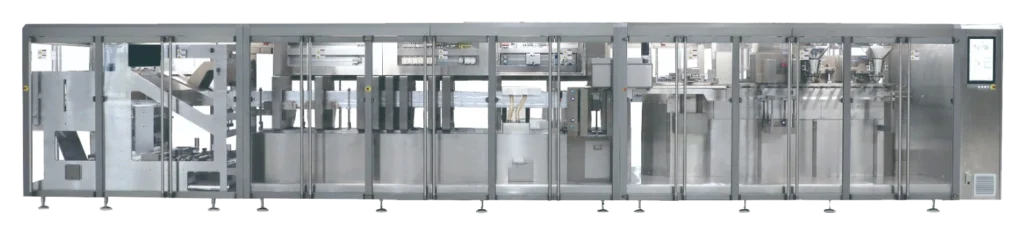
Investing in a Horizontal Form Fill Seal (HFFS) machine is about far more than replacing manual packaging. It is about improving production efficiency, reducing operational costs, and creating a packaging process that can grow with your business.
While every manufacturer’s return on investment (ROI) will differ depending on production volumes, product type, labour costs, and packaging requirements, most businesses discover that an HFFS machine pays for itself through a combination of:
Understanding where these savings come from helps manufacturers make informed purchasing decisions and accurately estimate their payback period.
ROI (Return on Investment) measures how quickly the financial benefits generated by an HFFS machine recover the initial investment.
Instead of looking only at the purchase price, ROI considers the ongoing operational savings created by automation.
Typical savings include:
The combined effect often results in a significantly lower packaging cost per unit.
Manual packaging often requires multiple operators for:
An automated HFFS system combines several of these steps into one continuous process.
Benefits include:
Rather than eliminating jobs, many manufacturers reassign staff to higher-value production tasks.
One of the biggest hidden costs in packaging is product giveaway.
If every pouch contains slightly more product than required, the excess accumulates into substantial losses over thousands or millions of packs.
Modern HFFS systems help minimise giveaway through:
Even a very small reduction in overfilling can generate significant annual savings.
Poorly controlled packaging processes often waste film due to:
Modern HFFS machines use precision controls that improve film utilisation and reduce scrap.
Less wasted packaging material means lower operating costs and reduced environmental impact.
An HFFS machine can package products significantly faster than manual operations.
Higher throughput allows manufacturers to:
Higher production capacity often becomes one of the largest contributors to ROI.
Consistent sealing and accurate filling reduce:
Improved packaging quality reduces both direct production losses and long-term customer dissatisfaction.
Modern HFFS machines include features such as:
These features reduce production interruptions and improve equipment availability.
Every factory operates differently, but the basic ROI calculation follows the same approach.
Determine how much labour automation replaces or reallocates over one year.
Example considerations:
Estimate how much product is currently overfilled.
Consider:
Small improvements in fill accuracy can create surprisingly large annual savings.
Measure reductions in:
Multiply the reduction by annual production volumes.
Estimate the additional production capacity gained through automation.
Higher throughput can generate:
Add together:
This gives your estimated annual financial benefit.
The basic formula is:
Payback Period = Machine Investment ÷ Annual Savings
For example:
If annual savings are substantial, the investment may be recovered within a relatively short period. The exact payback depends on production volumes, labour costs, machine configuration, and operational efficiency.
Several variables influence how quickly your investment pays for itself.
Higher production volumes generally deliver faster ROI because cost savings accumulate across more packaged products.
Products with a higher value often benefit more from improved fill accuracy and reduced giveaway.
Facilities with labour-intensive packaging processes usually experience larger savings after automation.
A machine operating consistently across multiple shifts will generally provide a faster return than one used only occasionally.
Machines designed for quick changeovers minimise downtime and improve overall equipment utilisation.
Many benefits are difficult to express in simple financial terms but still create long-term value.
These include:
These operational improvements often become just as valuable as the measurable cost savings.
An HFFS machine is often a worthwhile investment if you:
If your packaging operation is growing, calculating ROI can help determine the most suitable automation strategy.
At SA Packaging Machinery, we help manufacturers evaluate more than just machine specifications. We assess your production process, packaging requirements, and operational goals to recommend solutions that deliver long-term value.
Our team can help you:
Whether you are upgrading from manual packaging or expanding an automated production line, we can help you make an informed investment.
The payback period varies depending on production volume, labour costs, product value, and the savings achieved through automation. High-volume operations typically see a faster return on investment than low-volume facilities.
The largest savings usually come from a combination of reduced labour, lower product giveaway, less packaging film waste, increased production output, and fewer rejected packs.
Yes. Even a small reduction in overfilling can result in significant annual savings when multiplied across thousands or millions of packaged products.
Yes. Modern HFFS machines improve film alignment, sealing consistency, and registration accuracy, helping to reduce scrap, damaged packaging, and material waste.
No. Labour savings are just one part of the equation. Improved productivity, lower waste, reduced downtime, higher packaging quality, and increased production capacity all contribute to the overall return on investment.