Servo technology has transformed the performance of modern Horizontal Form Fill Seal (HFFS) machines by replacing traditional pneumatic and mechanical systems with electronically controlled servo motors. The result is greater positioning accuracy, faster product changeovers, improved seal consistency, and reduced product waste.
Whether packaging powders, granules, liquids or solid products, servo-driven HFFS machines provide manufacturers with tighter process control and greater production flexibility.
This guide explains how servo technology works, where it is used in HFFS equipment, and why many manufacturers are choosing servo-driven packaging systems over pneumatic alternatives.
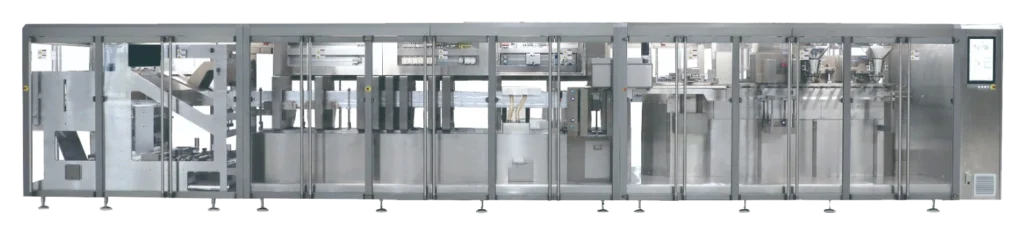
A servo system uses electronically controlled motors together with feedback sensors to precisely control machine movement.
Unlike pneumatic systems, which rely on compressed air and mechanical stops, servo motors continuously monitor their own position and make instant corrections while operating.
In an HFFS machine, servo motors can control:
Because every movement is digitally controlled, the machine maintains high accuracy even during long production runs.
One of the biggest advantages of servo technology is positioning precision.
Servo motors constantly receive feedback about their exact position, allowing them to adjust movement thousands of times per second.
This provides:
For branded packaging where graphics must align perfectly with seals and cut lines, servo control is especially valuable.
Printed packaging films contain registration marks that tell the machine exactly where each pouch should begin and end.
Servo-controlled film feeding allows the machine to automatically correct slight variations in the film during production.
Benefits include:
This is particularly important for retail-ready flexible packaging.
Manufacturers often package multiple products or pouch sizes throughout the day.
Traditional mechanical systems require manual adjustments using handwheels, gears and stops.
Servo-driven machines store production recipes digitally.
Changing from one product to another often involves:
This reduces downtime while improving repeatability between production runs.
Consistent sealing pressure and timing are critical for package integrity.
Servo motors provide accurate control over sealing jaw movement, helping produce:
Reliable seals are particularly important for food, pharmaceutical and medical packaging applications.
Packaging waste can occur due to:
Servo technology helps minimise these issues by maintaining precise machine control throughout production.
Benefits include:
Servo systems accelerate and decelerate more smoothly than pneumatic mechanisms.
This enables:
Manufacturers can often increase throughput while maintaining packaging quality.
| Feature | Servo Technology | Pneumatic Systems |
|---|---|---|
|
Position Accuracy |
Excellent |
Moderate |
|
Repeatability |
Excellent |
Good |
|
Speed Control |
Fully programmable |
Limited |
|
Changeovers |
Fast digital recipes |
Manual adjustments |
|
Film Registration |
Highly accurate |
Less precise |
|
Energy Use |
Efficient |
Requires compressed air |
|
Maintenance |
Lower mechanical wear |
Air system maintenance required |
|
Flexibility |
High |
Moderate |
Modern HFFS machines commonly use servo motors for:
Maintains accurate pouch length and registration.
Controls seal timing and pressure.
Provides accurate pouch separation.
Synchronises product movement with package formation.
Coordinates product discharge with packaging speed.
Automatically adjusts for printed film alignment.
Servo-driven HFFS machines are commonly used in:
Any production environment requiring high repeatability and minimal waste can benefit from servo technology.
Although servo-driven machines generally require a higher initial investment than pneumatic alternatives, many manufacturers achieve long-term savings through:
For businesses producing multiple product formats or running frequent production changes, servo technology often delivers significant operational advantages.
Servo technology uses electronically controlled motors with continuous feedback to accurately control movements such as film feeding, sealing, cutting and product positioning.
Yes. Servo motors provide significantly greater positioning accuracy than traditional pneumatic systems, resulting in more consistent packaging quality.
Yes. Improved positioning accuracy reduces film waste, rejected pouches, incorrect cuts and sealing errors.
Yes. Most servo-driven HFFS machines allow operators to save production recipes, making changeovers quicker and more repeatable.
Servo systems generally provide greater accuracy, flexibility and efficiency, while pneumatic systems may be suitable for simpler applications with lower automation requirements.
Servo technology has become a key feature of modern HFFS machines, offering manufacturers greater precision, improved sealing quality and faster production changeovers. By replacing manual mechanical adjustments with programmable electronic control, servo-driven systems help reduce waste, improve consistency and increase operational efficiency.
For manufacturers seeking reliable, high-performance packaging equipment, servo technology is an important consideration when selecting an HFFS machine.