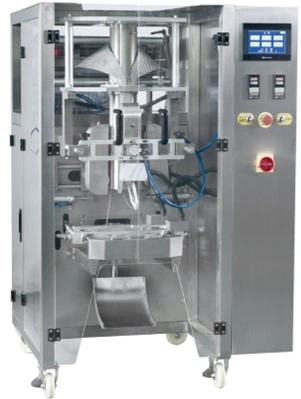
Investing in a Vertical Form Fill Seal (VFFS) machine is a major decision for any packaging operation. While the upfront cost can feel significant, the real value lies in long-term return on investment (ROI) driven by labour savings, reduced material waste, improved accuracy, and increased production speed.
This guide breaks down exactly how VFFS ROI works, what impacts it, and how to calculate payback in a real-world production environment.
To fully understand how ROI is achieved, it helps to first review how the system works in our VFFS machine guide.
In packaging, ROI measures how quickly your VFFS machine pays for itself through operational savings and efficiency gains.
A VFFS machine improves ROI by:
Manual bagging is labour-intensive. Most facilities require multiple operators per line.
Example:
Manual packaging line:
VFFS automated line:
Labour savings alone can reduce operational costs by 30%–70% per line, depending on production scale.
Manual filling often leads to overfilling (“product giveaway”) to avoid underweight packs.
VFFS machines improve accuracy using:
Example:
If you pack 10,000 units/month:
That small difference can cost thousands monthly in lost product.
Improved accuracy can save 2%–8% of product cost annually.
VFFS machines optimise film usage and reduce:
Servo-driven systems further improve:
Material waste reductions typically improve efficiency by 5%–15%.
Manual packing is slow and inconsistent.
A VFFS machine can typically achieve:
Result:
More output = more revenue capacity without increasing labour costs.
ROI varies depending on:
Higher volume = faster ROI
Semi-automatic vs fully servo-driven systems
Higher wage environments = faster ROI
Expensive film increases savings potential
Fewer breakdowns = higher ROI
| Factor | Manual Packaging | VFFS Machine |
|---|---|---|
|
Labour requirement |
High |
Low |
|
Accuracy |
Inconsistent |
High precision |
|
Speed |
Low–Medium |
High |
|
Waste |
High |
Low |
|
Scalability |
Limited |
High |
|
ROI |
None |
Strong long-term |
The biggest driver of ROI is the shift from labour-intensive processes to automation, which we explore in our comparison of manual packaging vs VFFS systems.
A VFFS machine is usually worth investing in when:
If you’re considering whether the investment is right for your operation, our VFFS buying guide outlines the key factors to help you make an informed decision.
A VFFS machine is not just a capital expense—it is a production efficiency asset.
Most businesses achieve ROI within 12–24 months, depending on volume and configuration, with ongoing savings thereafter.
Initial investment plays a key role in ROI calculations, and our breakdown of the cost of a VFFS machine in South Africa explains the key pricing factors.
Most machines achieve ROI within 12 to 24 months, depending on production volume and labour costs.
Labour reduction is typically the largest contributor, followed by reduced product waste.
Yes. Even lower-volume businesses benefit from reduced labour dependency and improved accuracy. These efficiency gains apply across multiple industries, which you can explore in our applications of VFFS machines guide.
No. ROI depends on correct machine selection, product type, and production demand.