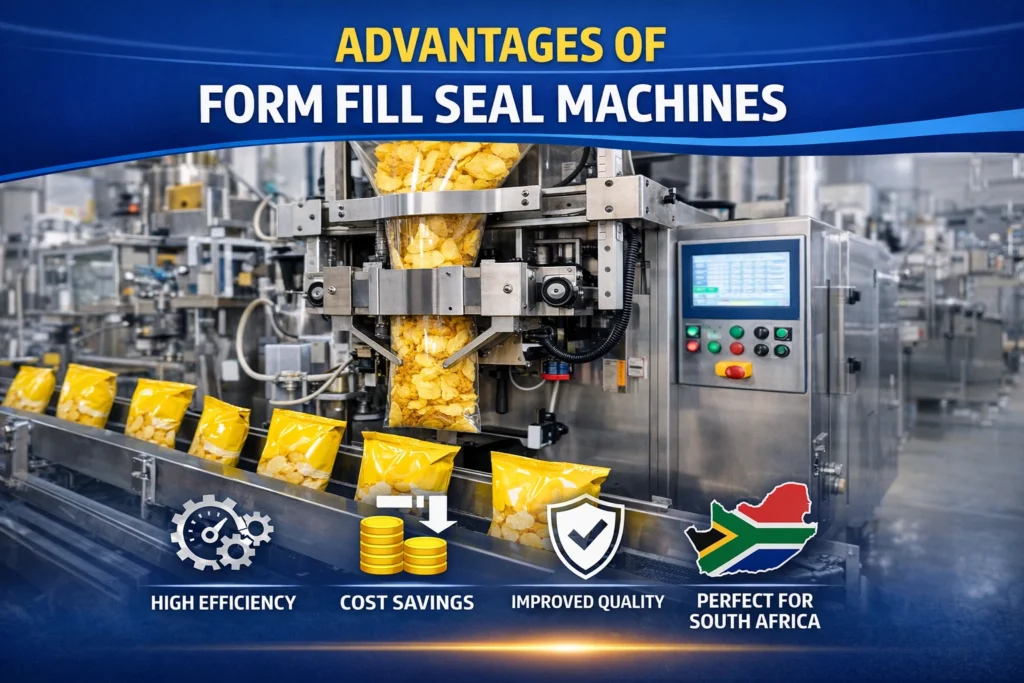
The advantages of Form Fill Seal machines are transforming the packaging industry by offering faster, more efficient, and cost-effective solutions for manufacturers. As businesses across South Africa look for ways to improve productivity and reduce operational costs, Form Fill Seal (FFS) machines have become a key investment in modern packaging lines.
Whether you are packaging food, pharmaceuticals, or non-food products, understanding how these machines work—and their benefits—can help you stay competitive in today’s demanding market.
Form Fill Seal machines are automated packaging systems that form packaging material into bags or containers, fill them with product, and seal them—all in one continuous process. These machines are widely used in industries such as food processing, cosmetics, agriculture, and manufacturing.
They are available in two main types:
Both types deliver high efficiency, but choosing the right one depends on your product type and packaging requirements.
One of the biggest advantages of Form Fill Seal machines is their ability to automate the entire packaging process. This significantly reduces manual labour and increases production speed.
With continuous operation, businesses can package thousands of units per hour, making FFS machines ideal for high-demand environments.
FFS machines help reduce costs in multiple ways:
By forming packaging directly from film rolls, these machines eliminate the need for pre-made packaging, which can be more expensive.
Consistency is crucial in packaging. FFS machines ensure:
This not only improves product presentation but also enhances brand reputation and customer satisfaction.
Another key benefit is versatility. The advantages of Form Fill Seal machines extend across multiple industries, including:
They can handle powders, liquids, granules, and solid items, making them highly adaptable for different applications.
Automation reduces human contact with products, which is especially important in industries like food and pharmaceuticals. FFS machines are designed to meet strict hygiene standards, helping businesses comply with safety regulations.
Compared to traditional packaging setups, FFS machines have a compact footprint. This makes them ideal for facilities with limited space while still delivering high output.
As your business grows, your packaging needs will increase. FFS machines can easily scale with your production requirements, allowing you to increase output without major infrastructure changes.
In South Africa’s competitive manufacturing landscape, efficiency and cost control are critical. Companies are increasingly adopting automated packaging solutions to:
The advantages of Form Fill Seal machines make them a smart investment for businesses looking to future-proof their operations.
When selecting an FFS machine, consider:
Working with an experienced packaging machinery provider ensures you get the right solution tailored to your needs.
Looking to upgrade your packaging process with a Form Fill Seal machine?
SA Packaging Machinery offers a wide range of automated packaging solutions designed for South African manufacturers. Our team can help you choose, install, and maintain the right equipment for your business.
Contact us today to discuss your requirements and get a tailored solution that improves efficiency and reduces costs.
Form Fill Seal machines are used in food, pharmaceuticals, agriculture, chemicals, and many other industries that require efficient packaging.
The main advantages of Form Fill Seal machines include increased efficiency, reduced costs, improved consistency, and enhanced hygiene.
Yes, depending on the model. Many FFS machines are scalable and can be adapted for small to medium-sized operations.
VFFS machines package products vertically (ideal for powders and grains), while HFFS machines package products horizontally (ideal for solid or shaped items).
They reduce costs by minimizing material waste, lowering labour requirements, and eliminating the need for pre-made packaging.