
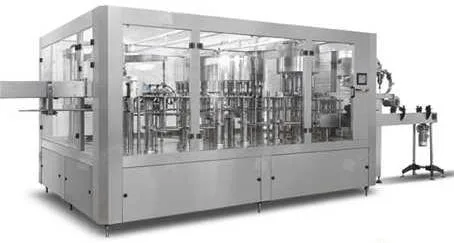
Gravity, overflow, piston and pump fillers for bottles, on their own or in a line that rinses, caps and labels.
Key Takeaways
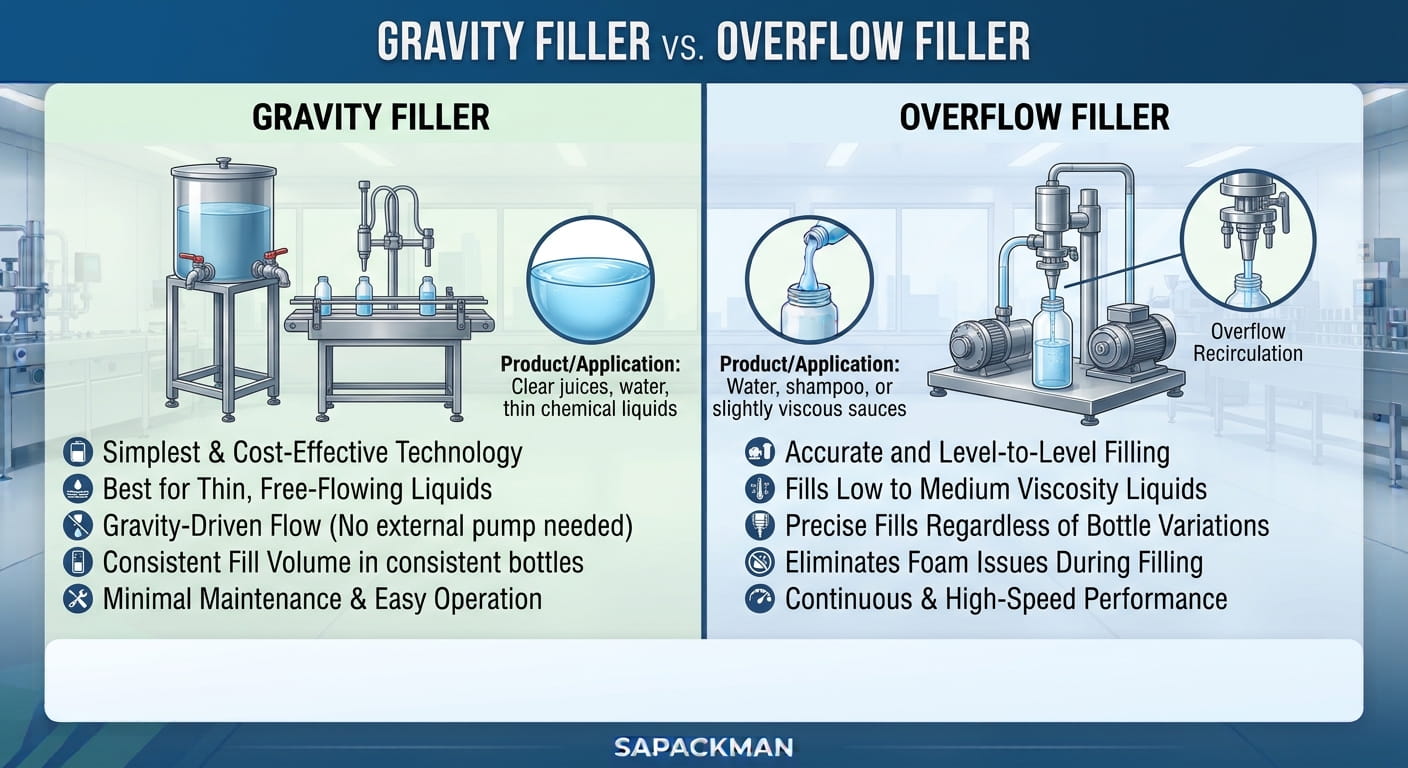
Liquid runs from a tank above the bottles while the valve is open, so each bottle gets the same amount.
Each bottle fills up to a set level and the excess goes back to the tank, so every bottle shows the same level.
Thick products need a piston filler, and carbonated drinks need an isobaric filler that keeps the gas in.
Choose a gravity filler for fast, simple filling of thin, free-flowing liquids such as water, alcohol and non-carbonated juice. Choose an overflow filler when every bottle has to show the same fill level, which matters most in clear bottles on a shelf. The difference in one line: a gravity filler controls the amount that goes into the bottle, and an overflow filler controls the level it reaches. Both suit thin liquids only. See the bottle filling machine for the lines we supply.
A gravity filler controls the amount of liquid that goes into each bottle, and an overflow filler controls the level the liquid reaches. Bottles of the same size are never exactly the same inside, so the same amount can sit at slightly different heights. In an opaque bottle nobody sees it. In a clear bottle on a shelf, an even level looks right, and that is what an overflow filler gives.
| Gravity filler | Overflow filler | |
|---|---|---|
| How it fills | Liquid runs down from a tank above the bottles while the valve is open | Liquid fills the bottle up to a set level, and the excess returns to the tank |
| What it controls | The amount that goes in | The level the liquid reaches |
| Fill level in clear bottles | Can vary slightly where bottles vary in size | The same visible level in every bottle |
| Best for | Water, alcohol and non-carbonated juice, where speed and simplicity matter | Water, juice and cleaning liquids sold in clear bottles, where the shelf look matters |
| Products to avoid | Thick products and carbonated drinks | Thick products and carbonated drinks |
| Hot or cold | Fills hot or cold, temperature set to the product | Fills hot or cold, temperature set to the product |
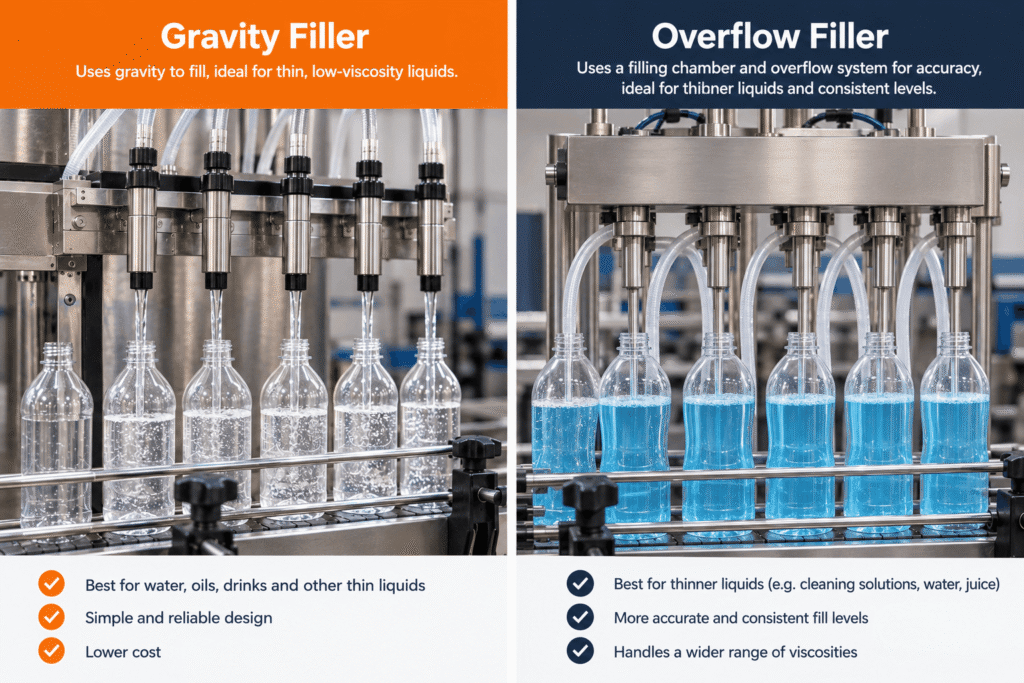
A gravity filler lets liquid run down from a tank above the bottles. Each filling valve opens for a set time, and the liquid flows into the bottle under its own weight. Because the flow is steady on a thin liquid, the same time gives the same amount in every bottle.
Gravity filling works well for water, alcohol and similar thin liquids, especially non-carbonated juice. It is simple, quick to clean between runs and fast on thin products, which is why water and juice lines usually build it into a 3-in-1 machine that rinses, fills and caps. The juice 3-in-1 we have supplied fills through 16 stainless steel large-flow valves at about 83 bottles a minute on 500 ml.
A gravity filler fills hot or cold, with the temperature set to suit the product. It needs a product that flows evenly, so thick liquids fill too slowly and unevenly by gravity.
An overflow filler fills each bottle to a set level rather than a set amount. The nozzle seals on the bottle neck and the liquid fills the bottle up to the nozzle height. Once it reaches that level, the extra liquid flows back to the tank instead of into the bottle, so every bottle ends at the same height.
That is why an overflow filler suits water, juice and cleaning liquids sold in clear bottles, where the fill level shows. For liquids that foam, such as some cleaning products, the fill speed is set to control the foam.
An overflow filler also fills hot or cold, with the temperature set to suit the product. Like a gravity filler, it is built for thin liquids.
Choose a gravity filler when speed and simplicity matter more than the look of the fill line. A gravity filler suits:
Choose an overflow filler when every bottle on the shelf has to look the same. An overflow filler suits:
Thick products and carbonated drinks need a different filler. Sauces, creams, honey and juice with fruit pulp fill on a piston filler, which pushes the same volume on every stroke; see piston filler vs pump filler. Carbonated drinks need an isobaric filler that keeps the gas in the drink while it fills; see still vs carbonated liquids. For the wider choice of filling machine, read how do you choose a bottle filling machine.
For fast filling of water, alcohol and non-carbonated juice, a gravity filler is the simpler choice. For clear bottles where the fill line has to match, choose an overflow filler. Both are set out on the bottle filling machine page. Send us a sample and a bottle, and we will trial it before we quote.
Send us your liquid, your bottle and the fill volume you need, and we will tell you whether a gravity or overflow filler suits it.