
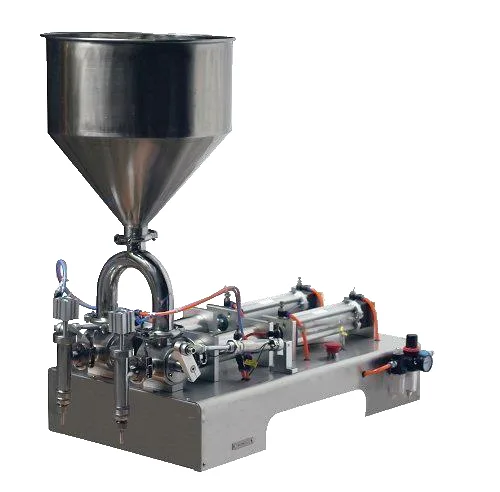
Semi-automatic and automatic piston fillers for thick liquids, pastes and products with pieces, with the lines we have supplied.
Key Takeaways
Each stroke draws a fixed dose into the cylinder and pushes it out, so thick products fill to the same level every time.
The pump type and its controls set the dose, so one pump filler can cover a wide range of thinner liquids.
Thick products and pieces suit a piston. Several thin products, quick changeovers and hygienic filling suit a pump.
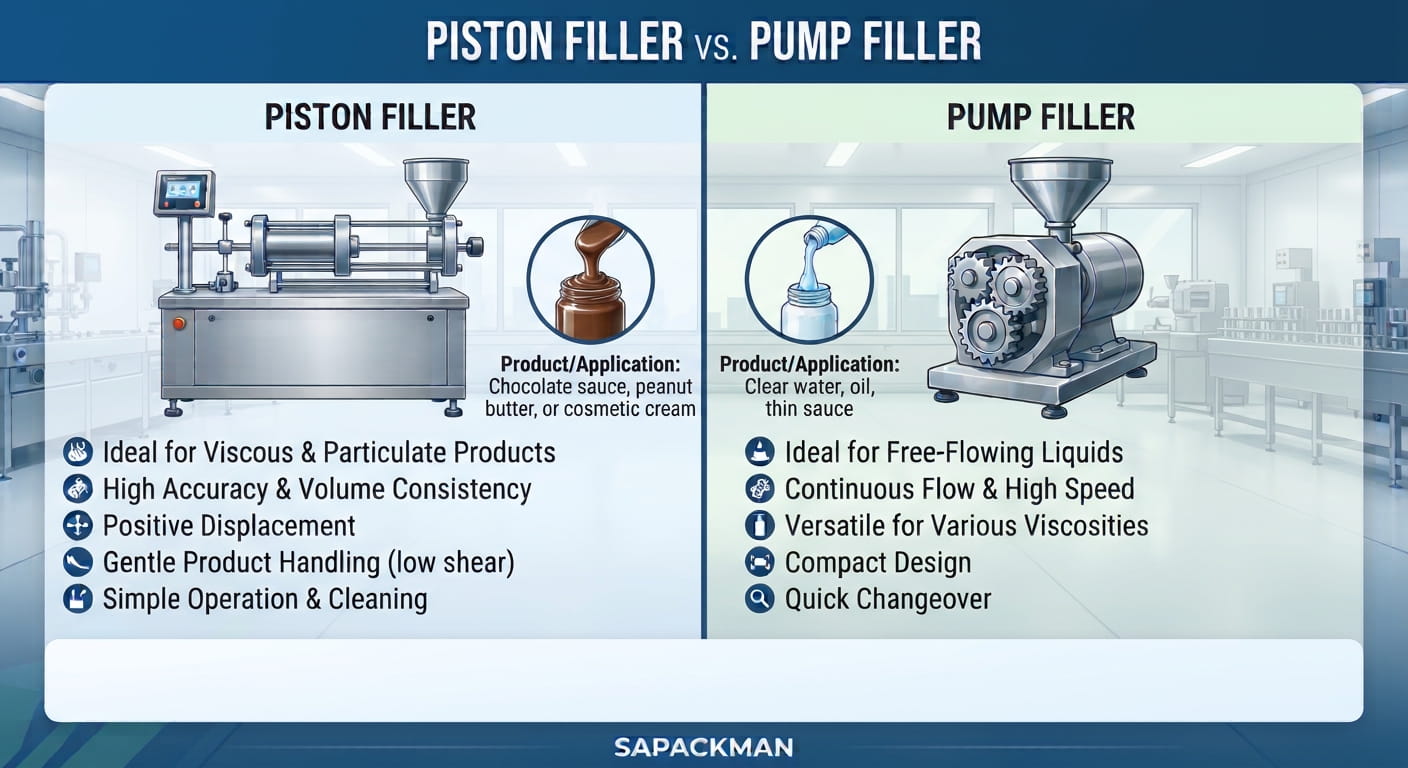
Choose a piston filler when your product is thick or carries pieces, and a pump filler when you fill a range of thinner liquids or need hygienic dosing. The difference in one line: a piston filler controls volume, and a pump filler controls flow. A piston draws the same dose into a cylinder on every stroke, while a pump filler moves product until its controls stop the flow. Neither is better in general. The right one is the one that suits your product. See the piston filler for the machines we supply.
A piston filler controls the volume of each dose, and a pump filler controls the flow of product into the container. That one difference explains most of the others: a piston gives a repeatable dose on thick products, and a pump gives flexibility across many liquids and faster changeovers.
| Piston filler | Pump filler | |
|---|---|---|
| How it doses | Draws a fixed volume into a cylinder and pushes it out on every stroke | Moves product through a pump; the controls stop the flow at the set dose |
| What it controls | Volume | Flow |
| Best for | Thick products and products with pieces: jam, sauces, creams, honey, pastes | A range of thinner liquids; small hygienic doses on a peristaltic pump; very thick products on a lobe pump |
| Accuracy | Set by the cylinder volume, so it stays the same whatever the thickness | Set by the pump and how well the control system manages it |
| Changeover | Change the cylinder volume or nozzle for a new product | Change the flow settings; a peristaltic pump only needs new tubing |
| Limits | Slower than a pump at high outputs; pieces must pass the valve and nozzle | A gear pump’s gears touch the product, which rules out some products |
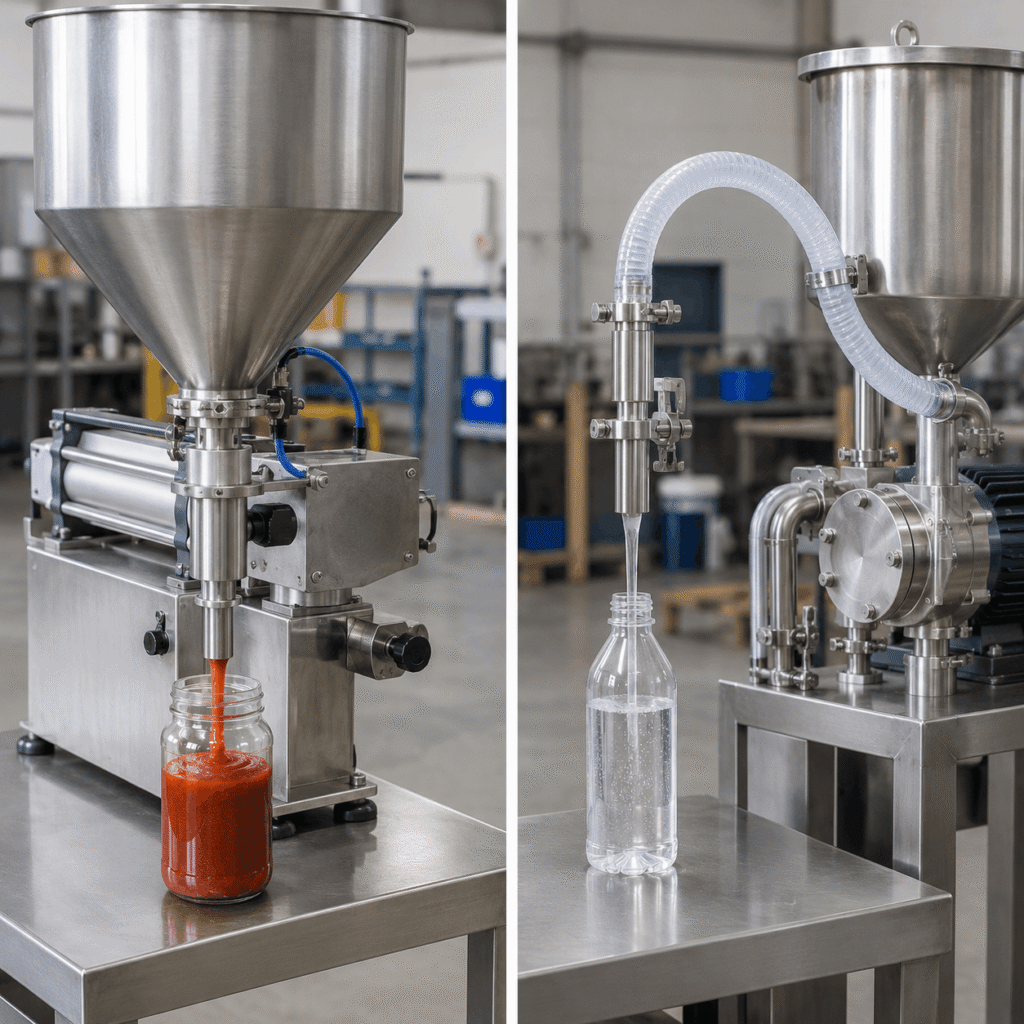
A piston filler measures each dose by volume. A piston moves back inside a cylinder to draw in a set amount of product, then forward to push it out through the nozzle. Because the cylinder holds the same volume on every stroke, the fill stays the same however thick the product is.
That makes a piston filler the usual choice for jam, sauces, creams, honey and pastes, including products with pieces such as juice with fruit pulp. The semi-automatic double-head piston filler we have supplied fills 50 to 500 ml or 500 ml to 5 litres to within 0.5%. On an automatic line, the 6-head piston filler we have supplied fills 100 ml to 1 litre at 13 to 20 bottles a minute on 500 ml.
The limits are speed and particle size. A piston filler is slower than a pump filler at high outputs, and any pieces in the product have to pass through the valve and nozzle.
A pump filler moves product from the tank to the container through a pump, and its controls stop the flow when the dose is reached. What a pump filler can do depends on the pump it uses:
On lines we have supplied, a peristaltic pump fills 5 to 50 ml into glass bottles at 15 to 20 a minute, and a 4-head lobe pump filler fills 50 ml to 1 litre at 20 to 30 bottles a minute. On a rotary spout pouch machine, a servo-controlled magnetic pump fills 100 ml to 1 litre through the spout at 16 to 41 pouches a minute, to within 1%.
A pump filler’s accuracy depends on the pump and how well the control system manages it. A gear pump’s gears touch the product, which rules out some products.
Choose a piston filler when the product is thick or the dose has to be repeatable from fill to fill. A piston filler suits:
For lower volumes, a semi-automatic piston filler is the usual starting point, and the same product can move to a multi-head automatic piston filler as output grows. For that step, see automatic vs manual liquid filling.
Choose a pump filler when the line runs several products or needs hygienic dosing. A pump filler suits:
Very thick products are the exception to the piston rule: grease and other products too thick for a piston run on a lobe pump filler. For every filler we supply for liquids, see liquid filling machines. Thin liquids that fill by gravity are covered in gravity filler vs overflow filler.
The surest way to choose between a piston filler and a pump filler is to fill your own product on both. Send us a sample with your container and the fill volume you need, and we will run it at our Riversands showroom before you order. Tell us how many products the machine has to fill and your target output, because a line that changes product often leans towards a pump filler.
If your product is thick or carries pieces, start with the piston filler. If you fill several thinner liquids or need hygienic small doses, a pump filler is the better fit, and liquid filling machines sets out the range. Either way, send us a sample and we will trial it before we quote.
Send us your product, your container and the fill volume you need, and we will tell you whether a piston or pump filler suits it.